Construction Billing Software That Contractors Actually Trust
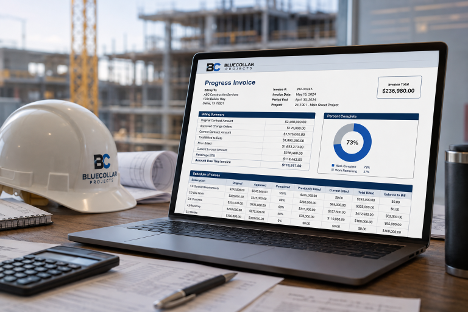
Construction billing rarely breaks because the invoice screen is confusing. It breaks because the story behind the invoice is scattered across emails, spreadsheets, field notes, and someone's memory of what was "approved in the meeting." That's how contractors end up with late invoices, disputed change work, missing retainage, and WIP that doesn't match what the field swears is happening.
A strong construction billing platform has to do more than print an invoice. It needs to connect the pieces that determine whether you get paid: job budgets tied to cost codes, committed costs captured before bills arrive, time captured and approved quickly, and change orders tracked early enough to bill them cleanly. BlueCollar's approach is built around that reality inside NetSuite, so billing doesn't live in its own world separate from project execution.
What "Construction Billing Software" Should Really Solve
If you're shopping for construction billing software, you're probably feeling one or more of these pressures: invoices go out late, margins are a surprise, change orders don't get billed consistently, or cash flow feels unpredictable even when crews are busy. Those aren't separate problems. They're all symptoms of one core issue: billing isn't tied tightly enough to the job's financial truth.
In a contractor's world, the invoice is the output of a chain of events. Someone created a budget, someone committed to spending on subs and vendors, labor hit the job through time entry, a client requested changes, and the percent complete moved as work progressed. If those steps don't roll up into a single system of record, billing becomes a monthly scavenger hunt. A real billing solution reduces that hunt by making billing a repeatable workflow instead of a heroic effort.
Here's what the best systems consistently connect:
- Contract value and billing rules (progress, T&M, milestones, retainage).
- Change control that updates scope, budget, and billable value.
- Job costing that stays current enough to support WIP and margin decisions.
- Commitments so you're not "profitable" on paper while exposure piles up.
- A simple approval cadence that keeps time and costs from lagging.
That "connected chain" is the difference between billing that feels like admin work and billing that feels like control.
Why Billing Falls Apart In Growing Construction Teams
Small teams often get away with informal billing processes because the same few people touch everything. Growth changes the game. Now you've got multiple PMs, different billing styles, inconsistent cost coding, and approvals happening across too many channels. Leadership wants cleaner forecasting and faster cash collection, but the job team is running on instinct and workarounds because the system feels slow.
This is where "billing software" gets misinterpreted as a single module. You can't fix the billing outcome without fixing the inputs. If committed costs aren't captured early, if time isn't approved quickly, or if change requests stay in email until the end, you'll always be behind. NetSuite can support job costing and project financials, but contractors typically need construction-specific workflows to capture those inputs the way real projects operate.
BlueCollar is a NetSuite-native construction management solution, focused on keeping budgets, billing, and project financials aligned so teams don't have to reconcile across disconnected tools.
The Billing Workflows Contractors Need Most
Construction billing software has to support the patterns your contracts demand, and it has to do it without creating a paperwork tax that makes PMs and the field avoid the system. In practical terms, most contractors need a dependable way to run these workflows end-to-end.
Progress Billing That Matches What's Happening On Site
Progress billing is straightforward in theory: bill based on percent complete. In practice, teams struggle because percent complete lives in different places for different people. The field measures progress one way, PMs measure it another, and accounting is left trying to reconcile the two while the billing deadline passes.
A workable progress billing workflow relies on consistent project setup and a repeatable cadence. Your schedule of values, cost codes, and billing structure needs to be consistent enough that every project "starts the same way," even if every job plays out differently. Growing teams do best when they standardize the few inputs that matter, then review progress and billing position on a set weekly rhythm.
Retainage Tracking That Doesn't Become A Year-End Fire Drill
Retainage is one of those areas where small mistakes become big headaches. If retainage isn't tracked consistently by job, customer, and invoice, you end up with missing dollars, slow closeouts, and cash that you've effectively loaned out longer than necessary.
Good construction billing software treats retainage as part of the billing workflow, not a spreadsheet maintained by one person who's "the only one who knows how it works." The goal is simple: keep retainage visible and tied to the same system that manages invoices and job financials, so closeout isn't a separate project.
Change Orders That Don't Get Lost Between The Field And Billing
Change orders are where contractors quietly lose money. The work gets done, the paperwork lags, and billing ends up incomplete or disputed because there isn't a clean record of what changed, what it cost, and what's billable.
A practical process looks like this: the moment a change is requested, it gets logged with enough detail to track scope and rough impact, even if it's still pending approval. As it moves through statuses, it becomes more defined. Once approved, it updates the contract value and the job budget in a controlled manner so that billing reflects the actual scope, not the original estimate.
Time And Materials Billing That Doesn't Lag Two Weeks
T&M billing only works if time and expenses are captured quickly and approved consistently. If time approvals drift, you end up billing late, cash comes in late, and the job team starts treating time capture as optional. NetSuite's job costing capabilities depend heavily on time tracking flowing into project costs correctly, which is why approval cadence is not a minor detail.
For adoption, simplicity wins. Limit job and cost code choices to what people actually need, keep the workflow fast, and make it clear that clean time entry leads to fewer headaches and better job decisions.
The Hidden Feature Everyone Wants: Billing That Matches WIP
If you're running multiple projects, you know WIP isn't just a finance exercise. It's the scoreboard that tells you whether your billing matches your progress and whether margin is holding. WIP becomes unreliable when budgets, commitments, actuals, and change orders don't align, because then the percent complete is built on shaky ground.
If your billing software doesn't support clean WIP, you'll always be arguing about numbers instead of using them. The right setup makes WIP a management tool, not a reconciliation project.
How To Evaluate Construction Billing Software Without Getting Fooled
It's easy to demo an invoice screen. It's harder to demo the habits a system forces or encourages. If you want construction billing software that actually improves cash flow and reduces disputes, evaluate it on workflow, not features.
Ask questions like:
- Can we track commitments before invoices hit, so exposure is visible early?
- Do change orders connect to budget updates and billing updates?
- Can billing workflows support our contract types without constant workarounds?
- Does time flow into job costs quickly enough to support weekly decisions?
- Can leadership see budget vs committed vs actuals without waiting for month-end?
Also, pay attention to the "human side" of the system. Adoption and real-world execution are critical; especially for growing teams that need repeatable workflows rather than scattered tools. That's the right lens. If the workflow punishes the field or forces PMs into busywork, they won't keep it current, and billing will drift right back into spreadsheets.
Where BlueCollar Fits In A NetSuite Billing Stack
NetSuite is widely used as an ERP for project-based businesses, and Oracle highlights job costing and project finance capabilities as part of that ecosystem. But many contractors need a construction-specific structure around cost codes, commitments, billing patterns, and WIP so the platform reflects job reality.
If your company already uses NetSuite or is considering it, the key question isn't "Can we generate an invoice?" It's "Can we run the entire billing chain in one connected workflow so we stop losing time and margin to reconciliation?"
Make Billing A Workflow, Not A Scramble
If billing feels stressful, it's usually because it's happening too late in the process. The fix is to tighten the upstream inputs: commitments captured early, change requests logged as they happen, time approved fast, and a weekly review cadence that keeps the job story current.
If you want to see what this looks like inside NetSuite with BlueCollar Projects, book a demo, and we'll walk through how job costing, billing, and cash flow can connect in your environment.
Frequently Asked Questions About Construction Billing Software
What Is Construction Billing Software Used For?
Construction billing software helps contractors create invoices that align with contract terms such as progress billing, T&M, milestones, and retainage, while keeping billing tied to job progress. The best systems also connect billing to job costing, commitments, and change control, so teams aren't chasing details across tools. If your billing process depends on spreadsheets and email threads, software should reduce that dependency by standardizing the workflow. A good solution also makes reporting more reliable because invoices, costs, and contract value are connected.
What's The Difference Between Standard Invoicing Software And Construction Billing Software?
Standard invoicing tools are built for simple product or service invoices, not the realities of construction contracts and job-level financial tracking. Construction billing needs features such as retainage, percent-complete billing, schedule of values, and change-order workflows that update the contract value and budget. It also needs to reflect commitments and job-cost trends so that billing decisions are made with current information. Without those connections, you'll still end up reconciling everything manually each month.
How Do Change Orders Affect Construction Billing?
Change orders affect billing because they change the billable scope and often change the budget and schedule as well. If change requests aren't logged early and moved through clear statuses, teams end up doing work that never gets billed or gets billed late and disputed. A clean process records changes as soon as they're requested, then ties approvals to contract value and budget updates to keep billing aligned. This approach reduces disputes because the invoice matches an approved record rather than memory.
What Is Retainage And How Should Software Track It?
Retainage is the portion of payment withheld until certain milestones or project completion, and it needs consistent tracking to avoid lost cash at closeout. Software should track retainage by customer, job, and invoice so it's visible and collectible without manual spreadsheets. If retainage is handled informally, companies often miss release timing or can't reconcile totals confidently. Clean retainage tracking supports faster closeouts and more predictable cash flow.
Can NetSuite Be Used As Construction Billing Software?
NetSuite can support construction billing and job costing, especially for project-based businesses that need a single ERP for financial management and operations. Oracle highlights job costing and project finance features, including cost capture and job-level allocations, that directly impact construction billing workflows. Contractors often add construction-specific structures and workflows so the system matches real-world job execution, which is where NetSuite-native solutions like BlueCollar add value.
How Does Billing Tie Into WIP Reporting?
WIP connects billing, costs, and percent complete to show whether revenue recognition and job progress align. If billing is late or change orders aren't reflected in contract value, WIP can look wrong even if the field feels the job is on track. Clean WIP depends on consistent inputs: budgets, commitments, actuals, and approved changes. When those inputs live within a single connected workflow, WIP becomes a reliable management tool rather than a monthly argument.
What Should Contractors Look For In Billing Software If They're Growing Fast?
Growing companies need a repeatable project setup, consistent cost codes, and clear approval workflows to keep billing standardized across PMs and teams. Best practices for growing teams usually emphasize consistency more than complexity, because consistent inputs make reporting comparable and adoption easier. Look for software that supports your contract types, ties change control to billing, and makes committed costs visible so you're not surprised later. Also, pay attention to adoption: if it's too heavy for the field and PMs, the data won't stay current.