Construction Takeoff Software: How Contractors Can Build Cleaner Jobs From The Start

A construction job doesn't go bad on day one because someone suddenly forgot how to build. More often, the trouble starts earlier, inside the estimate. A missed quantity, a loose assumption, a rushed revision, or a budget that doesn't align with how the work will actually be tracked can follow the team throughout the project.
That's why the takeoff process deserves more respect than it usually gets. It's not just a preconstruction step that helps win the bid. It's the first version of the job's financial story. If that story is messy, project managers, accounting teams, purchasing teams, and leadership all inherit the cleanup.
At BlueCollar, we talk a lot about connected construction workflows because contractors don't need another isolated tool that creates more re-entry. They need systems that help the estimate connect to the budget, the budget connect to job costing, and job costing connect to real operational decisions.
What Construction Takeoff Software Actually Does
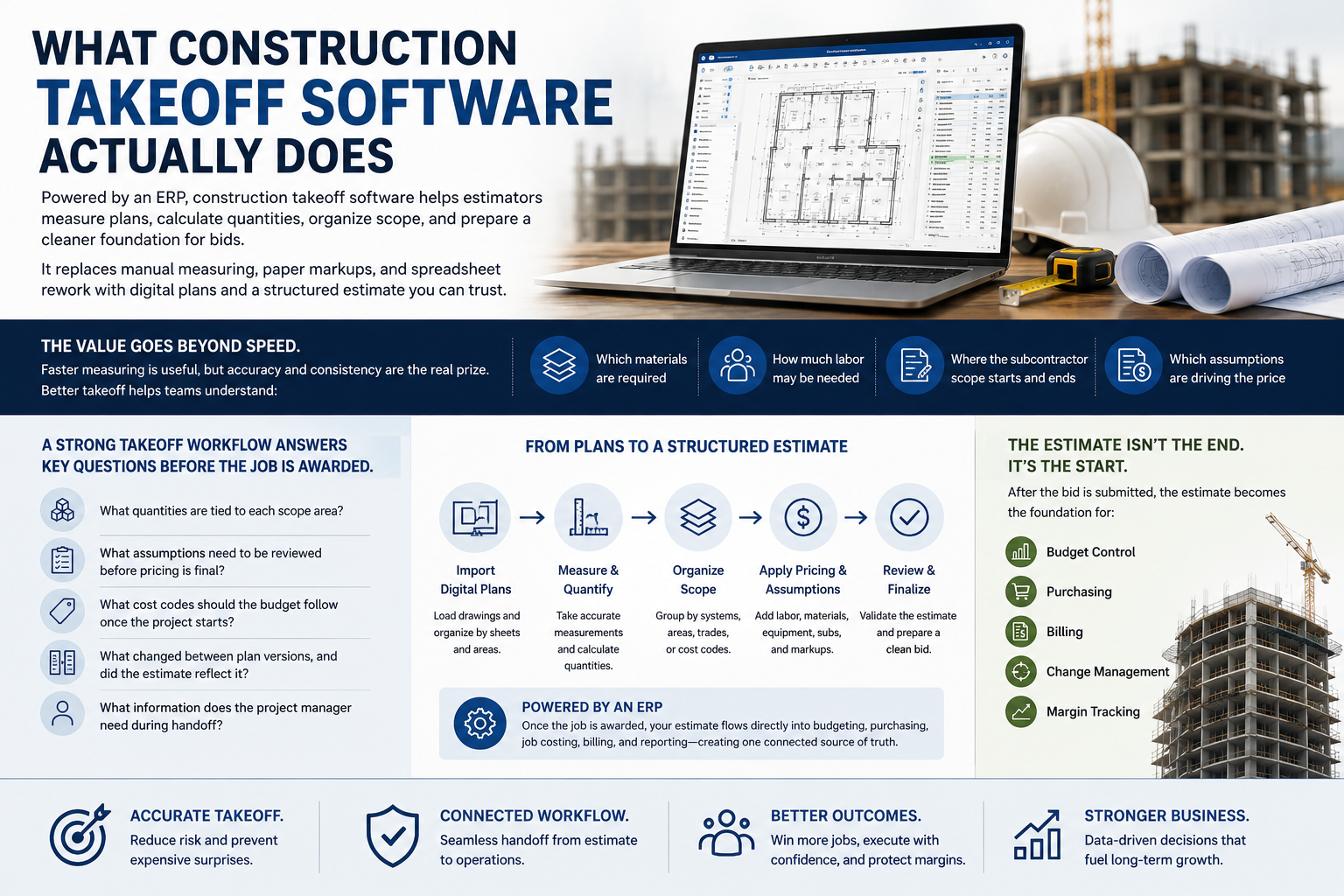
The construction takeoff software is powered by an ERP, and helps estimators measure plans, calculate quantities, organize scope, and prepare a cleaner foundation for bids. Instead of manually measuring drawings, marking up printed plans, or rebuilding quantities from scratch in spreadsheets, teams can work from digital plans and create a more structured estimate.
The value goes beyond speed. Faster measuring is useful, but accuracy and consistency are the real prize. A better takeoff process helps teams understand which materials are required, how much labor may be needed, where the subcontractor scope starts and ends, and which assumptions are driving the price.
A strong takeoff workflow should help contractors answer practical questions before the job gets awarded:
- What quantities are tied to each scope area?
- What assumptions need to be reviewed before pricing is final?
- What cost codes should the budget follow once the project starts?
- What changed between plan versions, and did the estimate reflect it?
- What information does the project manager need during handoff?
That last question is easy to miss. The estimate doesn't retire after the bid is submitted. It becomes the starting point for budget control, purchasing, billing, change management, and margin tracking.
Where Takeoff Breaks Down For Growing Contractors
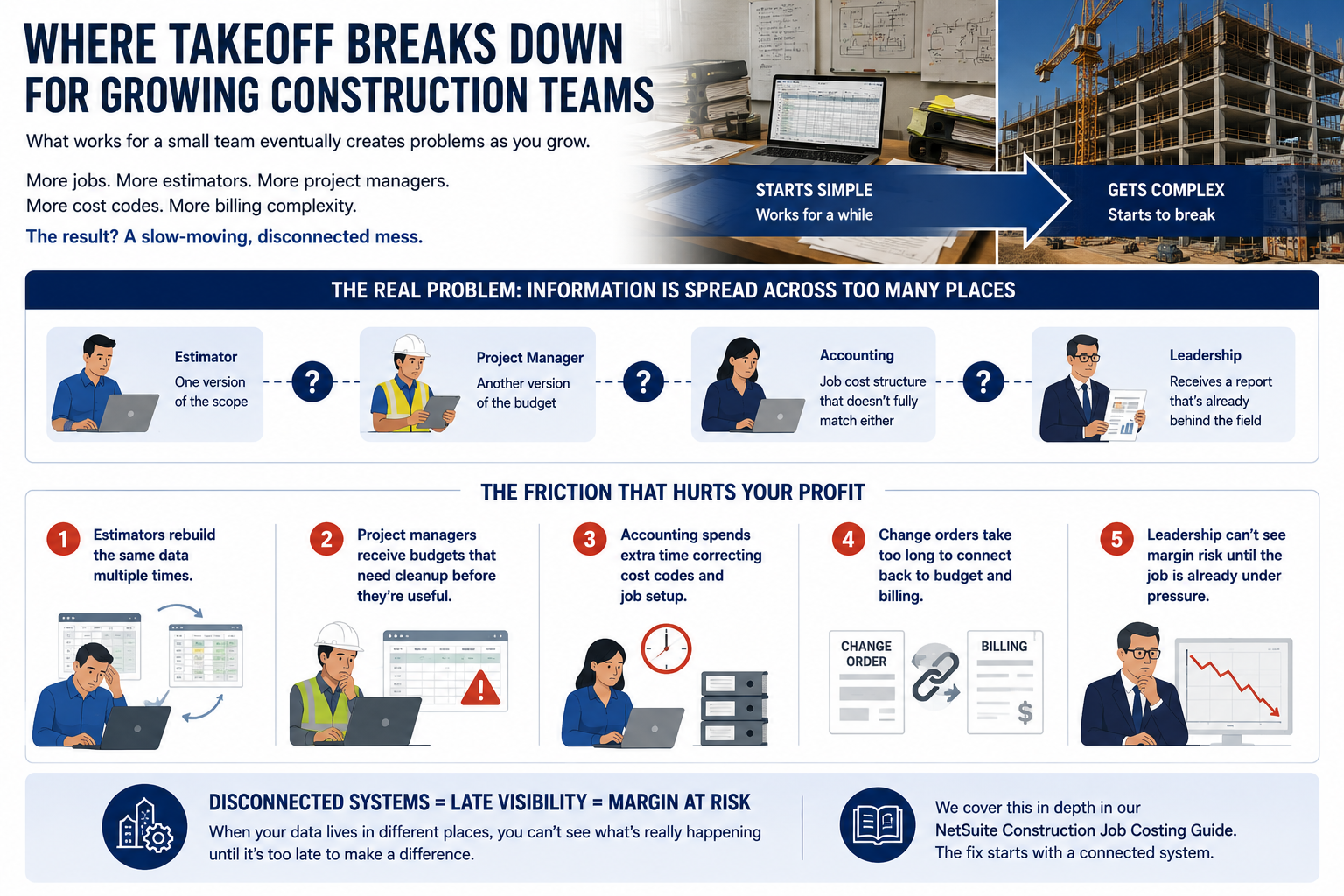
Small construction teams can survive for a while with spreadsheets, email threads, shared drives, and a few trusted people who "just know" where the numbers came from. That setup starts to crack as the company grows and scales. More jobs, more estimators, more project managers, more cost codes, and more billing complexity can turn a once-manageable process into a slow-moving mess.
The most common breakdown isn't that nobody has the information. It's that the information is spread across too many places. The estimator has one version of the scope. The project manager has another version of the budget. Accounting has a job cost structure that doesn't fully match either one. Leadership gets a report that's already behind the field.
That creates friction in places that directly affect profit:
- Estimators rebuild the same data multiple times.
- Project managers receive budgets that need cleanup before they're useful.
- Accounting spends extra time correcting cost codes and job setup.
- Change orders take too long to connect back to budget and billing.
- Leadership can't see margin risk until the job is already under pressure.
We've covered these same issues in our NetSuite construction job costing guide, where the core problem is simple: disconnected systems make it harder to see what's really happening before it's too late to act.
What Contractors Should Look For In A Better Takeoff Workflow
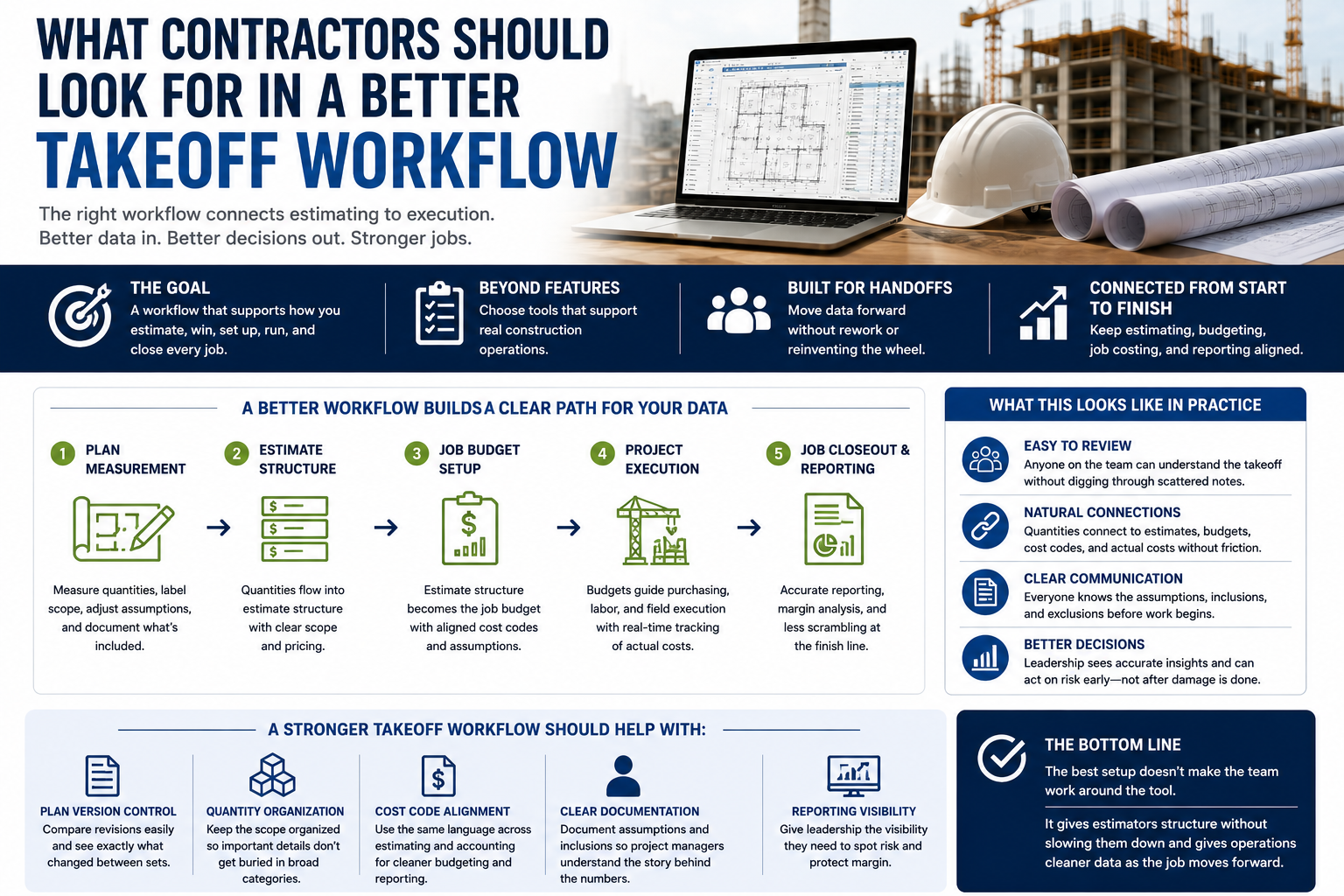
A better takeoff workflow shouldn't create a shiny new silo. It should support the way the company estimates, wins, sets up, runs, and closes jobs. That means the evaluation process should go beyond features and ask whether the tool can support real construction operations.
Plan measurement needs to be easy, clear, and reviewable. Estimators should be able to measure quantities, label scope, adjust assumptions, and document what they included. If someone else has to review the takeoff, the work should make sense without a long explanation or a hunt through scattered notes.
The workflow also needs to support clean handoffs. Quantitative data should connect naturally to the estimated structure. The estimate structure should support job budgets. Job budgets should align with the way the company tracks actual costs. If those pieces don't line up, the business ends up paying for the disconnect after the project starts.
A stronger workflow should help with:
- Plan version control, so teams can compare revisions without guessing what changed.
- Quantity organization, so the scope doesn't get buried in broad categories.
- Cost code alignment, so that estimating and accounting aren't speaking different languages.
- Clear documentation so that project managers understand the bid assumptions.
- Reporting visibility, so leadership can see where risk is building.
The best setup doesn't make the team work around the tool. It gives estimators structure without slowing them down and provides operations with cleaner data as the job moves forward.
Why Takeoff Data Should Connect To Job Costing
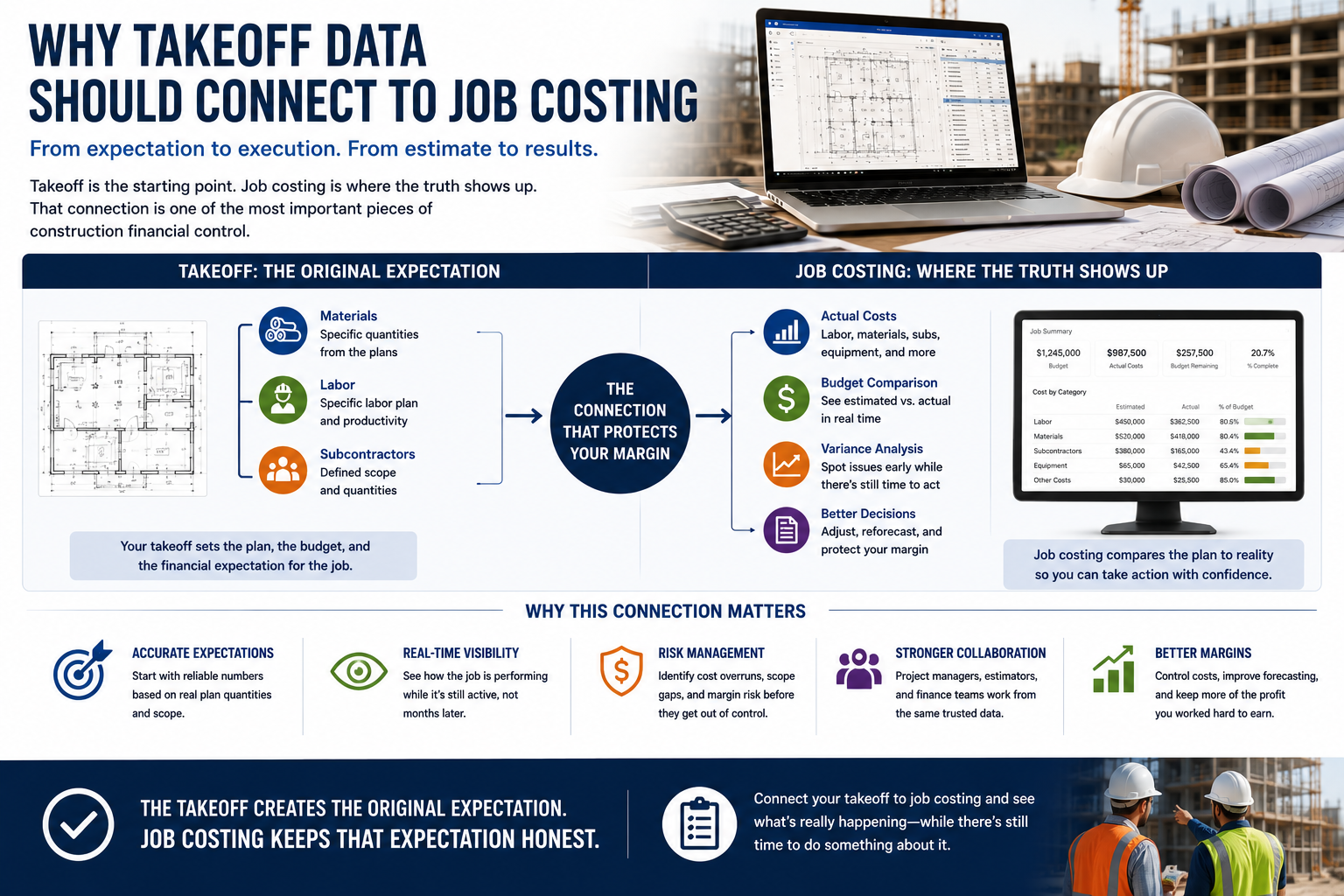
Takeoff is the starting point. Job costing is where the truth shows up. That connection is one of the most important pieces of construction financial control.
If the takeoff indicates the job should require a specific quantity of materials, a specific labor plan, and a specific subcontractor scope, the company needs a way to compare those assumptions against what happens in the field. Without that connection, teams are stuck working from memory, late reports, and after-the-fact explanations.
Good job costing helps contractors compare estimated costs to actual costs while the work is still active. It gives project managers a clearer view of labor, materials, subcontractors, equipment, committed costs, and budget movement. It also gives finance teams a better way to understand where margin is holding and where it's slipping.
That's exactly why we talk so often about construction cost tracking software. Contractors don't just need numbers. They need numbers they can trust, tied to the job structure they actually use.
The takeoff creates the original expectation. Job costing keeps that expectation honest.
How BlueCollar Thinks About Construction Data Flow
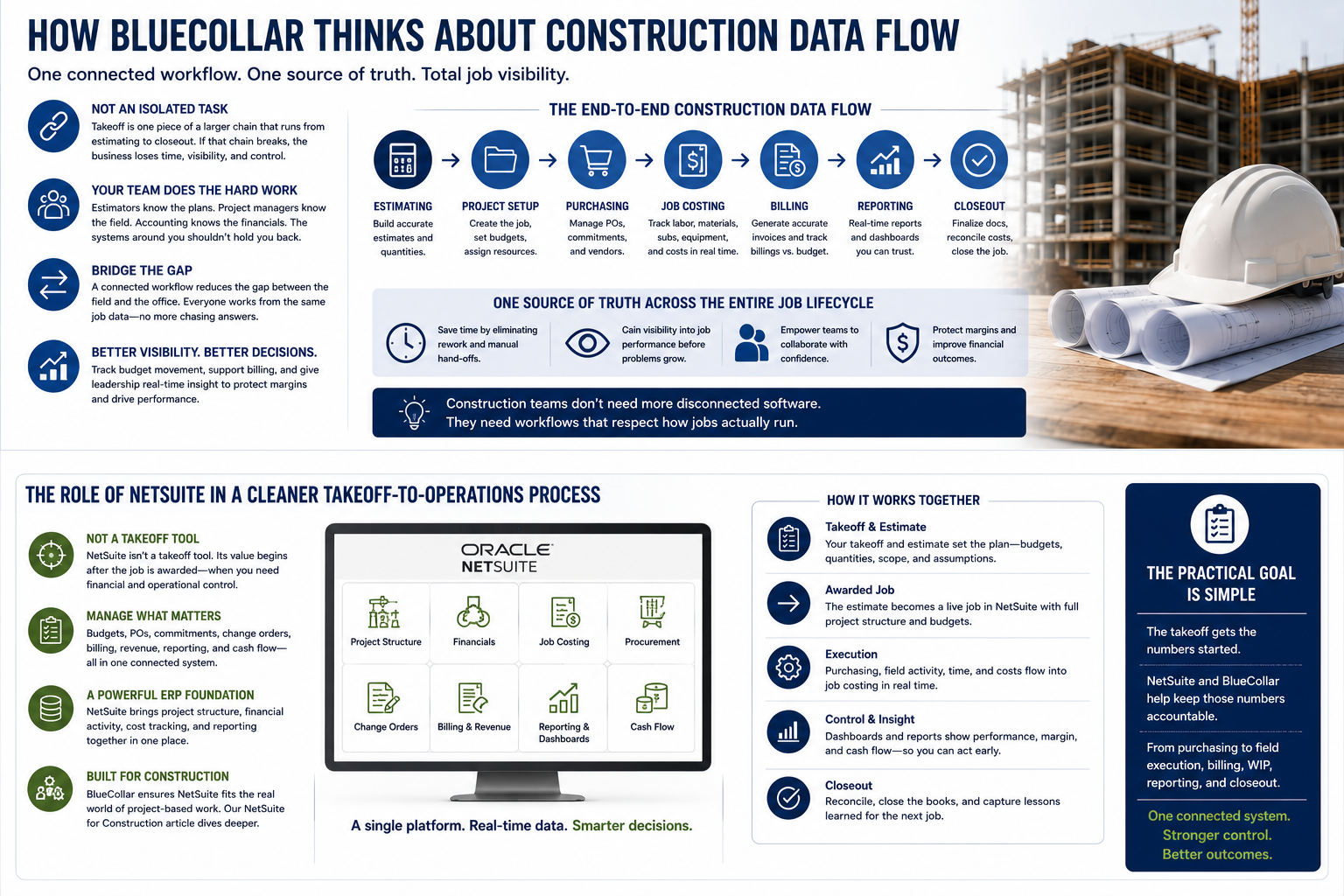
We don't see takeoff as an isolated task. We see it as one piece of a larger chain that runs from estimating to project setup, purchasing, job costing, billing, reporting, and closeout. If that chain breaks in the middle, the business loses time, visibility, and control.
Many contractors are already doing the hard work. Their estimators know the plans. Their project managers know the field. Their accounting teams know the financial pressure points. The problem is that the systems around them often make the work harder than it needs to be.
A connected construction workflow should reduce the gap between the field and the office. It should help finance and operations work from the same job data. It should make budget movement easier to track and billing easier to support. It should also help leadership stop chasing three different versions of the same answer.
That's the same idea behind our content on construction accounting and project management in NetSuite with BlueCollar Projects. Construction teams don't need more disconnected software. They need workflows that respect how jobs actually run.
The Role Of NetSuite In A Cleaner Takeoff-To-Operations Process
NetSuite is not a standalone takeoff tool, and contractors shouldn't think of it that way. Its value sits in the next stage of the workflow, where the estimate becomes a live job and the company needs financial and operational control.
Once a job is awarded, the business has to manage budgets, purchase orders, commitments, change orders, billing, revenue, reporting, and cash flow. That's where a connected ERP foundation becomes powerful. NetSuite can serve as the system where project structure, financial activity, cost tracking, and reporting come together.
BlueCollar helps construction teams ensure that the NetSuite environment fits the realities of project-based work. Our article on NetSuite for construction explains how contractors can use a stronger system to support growth, operations, and job costing in one place.
The practical goal is simple. The takeoff gets the numbers started. NetSuite and BlueCollar help keep those numbers accountable as the job moves through purchasing, field execution, billing, WIP, reporting, and closeout.
Practical Questions To Ask Before Choosing A Takeoff Tool
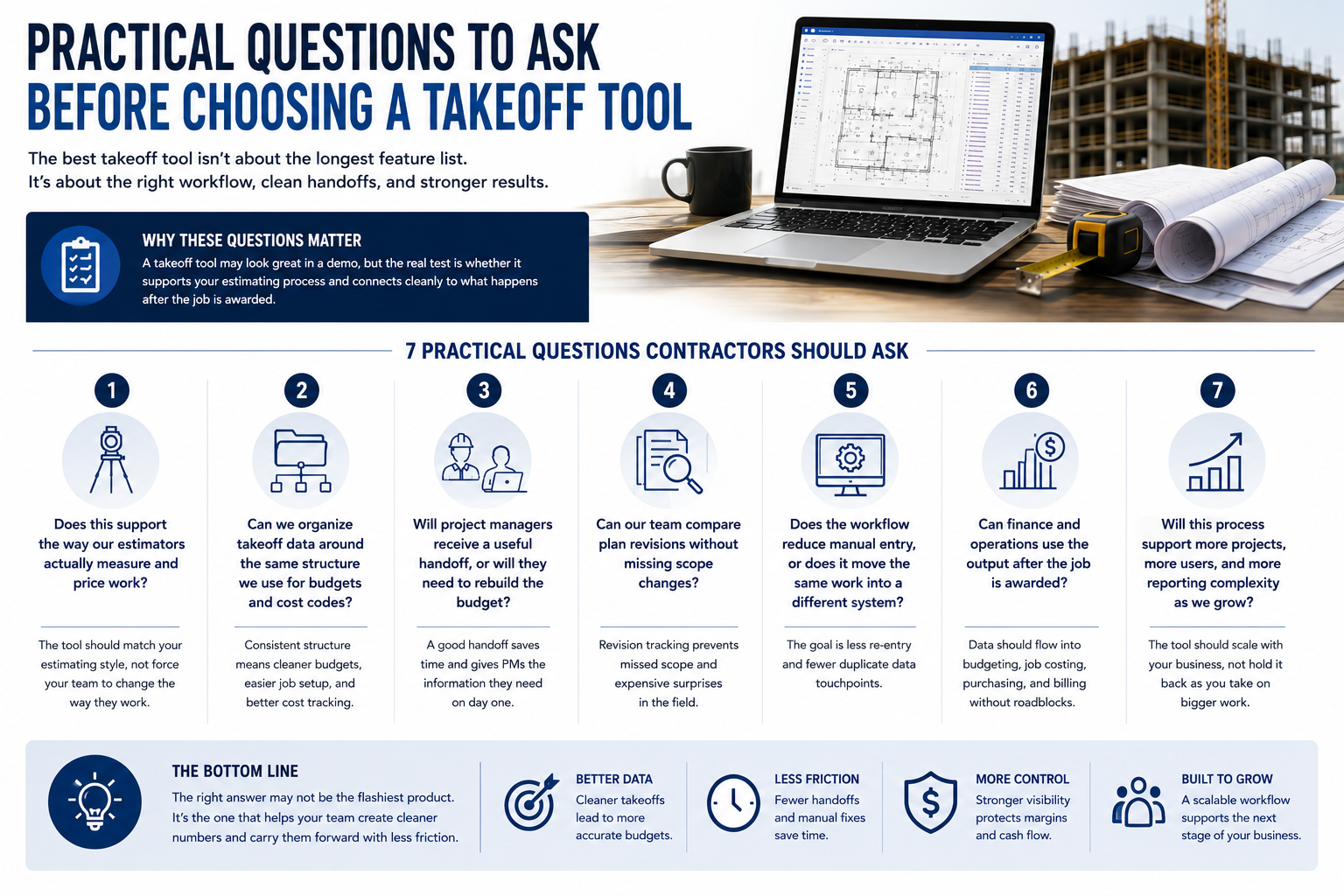
Software decisions get expensive when teams buy based on a feature list rather than a workflow. A takeoff tool may look impressive in a demo, but the real test is whether it supports the company's estimating process and connects cleanly to what happens after award.
Contractors should ask direct questions before choosing a tool:
- Does this support the way our estimators actually measure and price work?
- Can we organize takeoff data around the same structure we use for budgets and cost codes?
- Will project managers receive a useful handoff, or will they need to rebuild the budget?
- Can our team compare plan revisions without missing scope changes?
- Does the workflow reduce manual entry, or does it move the same work into a different system?
- Can finance and operations use the output after the job is awarded?
- Will this process support more projects, more users, and more reporting complexity as we grow?
The right answer may not be the flashiest product. It's the one that helps the team create cleaner numbers and carry them forward with less friction.
Common Mistakes Contractors Make With Takeoff And Estimating Data
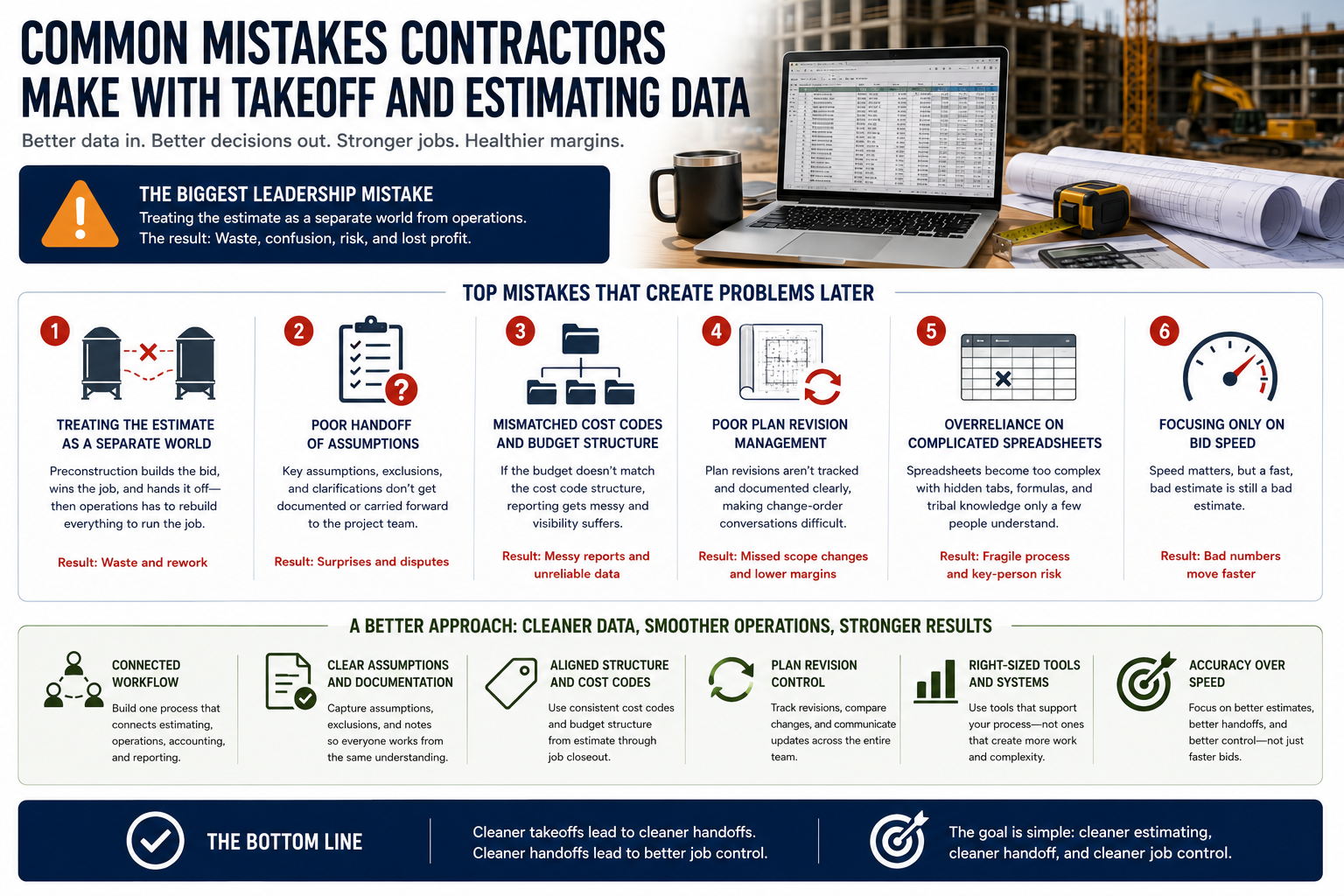
One of the biggest leadership mistakes that contractors make is treating the estimate as a separate world from operations. The preconstruction team builds the bid, wins the job, and hands it off. Then, project management and accounting have to reshape that information into something they can actually run.
That creates waste. It also increases risk. If the budget doesn't match the cost code structure, reporting gets messy. If plan revisions aren't documented clearly, change-order conversations get harder. If assumptions weren't carried into the handoff, the project manager may be held to numbers without knowing what's behind them.
Another common mistake is overbuilding spreadsheets to the point that only one or two people understand them. Spreadsheets can be useful, but they become fragile when they carry too much of the company's operating process. If every job depends on manual copying, custom formulas, hidden tabs, and tribal knowledge, the process is already telling you it needs help.
Contractors should also be careful not to focus only on bid speed. Speed matters, especially in competitive markets, but a fast, bad estimate is still a bad estimate. The goal is cleaner estimating, cleaner handoff, and cleaner job control.
How Better Takeoff Supports Billing And Cash Flow
Billing problems rarely begin at billing. They often start earlier, when the scope, budgets, change events, and project records aren't clear enough. If the original estimate is hard to trace, the billing process has less support when questions come up later.
Clean takeoff and estimating data can help teams support progress billing, change billing, and project financial reviews with more confidence. It gives the office a better record of what was included, what changed, and what needs to be tied back to the contract. It also helps project managers communicate budget changes before they turn into a billing dispute.
Contractors need billing workflows that align with actual project activity. That means cost data, change orders, contract details, and revenue events can't live in separate corners of the business.
When estimating, project management, accounting, and billing are better connected, cash flow gets easier to manage. The business can see what has been performed, what has been approved, what is ready to bill, and what still needs documentation.

Bring Preconstruction And Project Financials Closer Together
A construction company doesn't need more busywork disguised as innovation. It needs cleaner handoffs, better visibility, and fewer places for important job data to get lost. The takeoff process is one of the best places to start because it shapes the numbers every team depends on later.
If your estimators are working in one system, your project managers are rebuilding budgets somewhere else, and your accounting team is cleaning up the data after the job starts, there's a better way to run the process. The goal isn't to make software the center of the business. The goal is to give your people a system that keeps up with the way they already work.
BlueCollar helps contractors connect construction operations, project financials, job costing, billing, and reporting inside a NetSuite environment built for real project control. Schedule a demo with BlueCollar to see how your team can tighten the path from estimate to execution without adding another layer of chaos.
Frequently Asked Questions About Construction Takeoff Software
What Is Construction Takeoff Software?
Construction takeoff software is a digital tool used to measure plans, calculate quantities, organize project scope, and support the estimating process. Contractors use it to replace manual plan measurement, reduce dependence on spreadsheets, and create clearer bid documentation. The best workflows don't stop at measuring quantities. They help teams carry clean estimate data into budgeting, project setup, and job cost tracking.
How Does Construction Takeoff Software Help Contractors?
It helps contractors improve estimate accuracy, speed up quantity calculations, and create a more consistent process for reviewing plans. It can also reduce rework because estimators don't have to rebuild the same data in multiple places. For growing teams, the bigger benefit is structure. Cleaner takeoff data gives project managers, accounting teams, and leadership a stronger starting point once the job is awarded.
Is Takeoff Software The Same As Estimating Software?
Takeoff and estimating are closely related, but they are not always the same thing. Takeoff focuses on measuring plans and calculating quantities. Estimating applies pricing, labor, equipment, subcontractor costs, markup, overhead, and bid strategy to that information. Some tools combine both functions, while other contractors use separate tools and connect the output to their broader project and financial systems.
Can Takeoff Data Connect To Job Costing?
Yes, and that connection can make a major difference in project control. Takeoff data can help shape the original budget, cost code structure, and project assumptions used after award. Once actual costs start coming in, the team can compare field performance against the estimate. That makes it easier to spot overruns, missed scope, labor pressure, and purchasing issues before they become bigger financial problems.
What Features Should Contractors Look For?
Contractors should look for clear plan measurement, quantity tracking, revision comparison, estimate organization, cost code alignment, collaboration tools, and reporting options. The tool should also support how the company actually works, rather than forcing a strange process on estimators. Integration options are important too. If the data can't move cleanly into project management, accounting, billing, or ERP workflows, the team may still end up doing too much manual cleanup.
Does NetSuite Include Takeoff Software?
NetSuite is better understood as an ERP and operational platform, not a standalone takeoff tool. It can support the financial and project management side once the takeoff and estimate data are converted into budgets, commitments, costs, billing events, and reports. BlueCollar helps contractors make NetSuite more practical for construction workflows. That includes job costing, project financials, billing visibility, and the connected reporting contractors need after a job is awarded.
Why Do Takeoff Errors Hurt Project Margins?
Takeoff errors hurt margins by creating bad assumptions before the job even starts. Missed quantities, unclear scope, wrong labor expectations, and weak revision control can all lead to cost overruns later. Once the project is moving, those mistakes show up in purchasing, scheduling, change orders, and budget performance. Better takeoff discipline gives the team a stronger baseline and fewer surprises.
How Should Contractors Move From Takeoff To Project Management?
Contractors should standardize cost codes, clearly document assumptions, and ensure the awarded estimate becomes a usable project budget. The project manager should understand what was included, what was excluded, and where the bid carries risk. Accounting should receive a structure that supports job cost tracking without major cleanup. A connected workflow makes the handoff cleaner and helps the team manage the project from a shared set of numbers.
What Is The Best Way To Improve Takeoff Accuracy?
The best way to improve takeoff accuracy is to combine better tools with a more disciplined workflow. Estimators should review plan versions carefully, document assumptions, consistently organize scope, and involve operations when job complexity warrants it. Teams should also compare completed project costs with original estimates to make future bids sharper. Good data from past jobs is one of the strongest ways to improve the next estimate.