ERP For Construction Industry: How Contractors Build Better Control With BlueCollar And NetSuite

Construction companies do not fall behind because the work is simple. They fall behind because the business keeps moving while the systems struggle to keep pace. Crews are active. Vendors are changing prices. Project managers are chasing updates. Accounting is waiting on backup. Leadership wants clean numbers. Field teams need answers now, not after the next close.
That is the point where spreadsheets, disconnected accounting tools, and one-off project trackers start showing their limits.
A contractor can have talented people in every seat and still lose time to scattered data. One team knows the schedule. Another team knows the cost exposure. Someone else has the latest change order. Accounting has the invoice status. Leadership asks a basic question about job health, and the answer depends on which report someone opens first.
That is not a people problem. It is a systems problem.
The right construction ERP software gives contractors a cleaner way to run the business. It integrates financials, project work, job costing, billing, purchasing, scheduling, and reporting into a single shared environment. Instead of forcing teams to rebuild the truth from emails and spreadsheets every week, ERP gives the business one place to manage work while it is still in motion.
For construction companies considering NetSuite, BlueCollar helps make a powerful ERP platform practical for contractors. The goal is not software for the sake of software. The goal is control, cleaner data, stronger margins, and fewer surprises across every active job.
What ERP Really Means For Construction Companies
ERP stands for enterprise resource planning, but that phrase does not say much to a contractor trying to keep jobs profitable. In construction terms, ERP is the system that connects the financial side of the business to how projects actually run.
It is where estimates, budgets, commitments, actual costs, billing, procurement, project progress, schedules, and reporting meet.
Construction is different from a standard product-based business. Every job has its own cost structure, timeline, labor needs, subcontractor plan, materials flow, billing terms, and risk profile. One project may be ahead on schedule but behind on billing. Another may look profitable until late change orders, labor creep, or committed costs start catching up. A third may be generating revenue while cash flow still feels tight because retention and billing cycles are misaligned.
That is why the best ERP software for construction is not just a bigger accounting system. It needs to support job-level financial visibility, project accounting, billing workflows, change management, purchasing controls, and field-to-office coordination.
BlueCollar's approach is built around that reality. Contractors do not need a generic ERP setup that looks impressive in a demo and then creates more work after go-live. They need NetSuite configured around the way construction teams estimate, approve, buy, build, bill, forecast, and report.
A strong ERP for construction industry workflows should help the office and field work from the same version of the truth. That means the system should answer questions like:
- What has been budgeted for this job?
- What has been committed?
- What has actually hit the job?
- What has been billed?
- What is still exposed?
- What changed since the last forecast?
- Where is margin starting to move?
Those answers should not require five exports, three calls, and a spreadsheet cleanup session. They should be built into the way the business runs.
The Problem With Disconnected Construction Systems
Most contractors do not wake up one morning and decide they want an ERP system. The need usually shows up through friction.
A project manager cannot trust job cost data because it is already a week old. Accounting is waiting for field updates before billing can move forward. Leadership wants a margin report, but each department has its own version. Change orders are approved in conversation before they ever reach the financial system. Purchase orders sit in one place, invoices arrive somewhere else, and the project budget does not reflect the full picture until too late.
This is how margin leaks happen.
Disconnected systems create delays at the exact moments when contractors need speed and clarity. If cost data arrives after the decision window has closed, the report may be accurate but not useful. If billing depends on manual follow-up, cash flow slows down. If schedules are separate from procurement and labor planning, changes in one area do not flow through to the cost picture fast enough.
NetSuite for construction is one of the most common ERP conversations among contractors because it provides a single platform for financials, project operations, reporting, and workflow management. The question is not whether the technology exists. The question is whether it is set up to actually work for how construction companies operate.
Why NetSuite As The ERP Foundation
NetSuite gives construction companies a cloud-based ERP foundation for financials, project operations, reporting, purchasing, billing, and business management. For contractors, that foundation becomes especially valuable when it is shaped around real construction workflows.
A well-configured NetSuite environment can help teams connect cost codes, budgets, purchase orders, vendor bills, labor activity, project records, billing events, and reporting dashboards. Instead of waiting for accounting to reconcile what happened, project teams can work from cleaner information while the job is still active.
That changes the rhythm of the business.
Project managers can see budget versus actuals sooner. Accounting teams can reduce duplicate entry. Leadership can review performance across jobs without waiting for manual reporting. Billing teams can work from better backup. Purchasing activity can connect back to the job budget. Forecasting can become more reliable because the underlying data is not scattered across multiple tools.
BlueCollar's work with NetSuite for construction focuses on making the platform useful for contractors, not just technically available. That means aligning the system with job costing, project management, WIP reporting, billing, change orders, scheduling, and operational visibility.
The platform matters, but configuration matters just as much. A poorly designed ERP can create another layer of friction. A thoughtful setup gives contractors a cleaner operating system that supports growth, accountability, and faster decision-making.
That is where BlueCollar fits. We help construction companies make NetSuite reflect the work they actually do.
Job Costing Is Where Control Starts
Job costing is one of the main reasons construction companies consider ERP in the first place. If job costs are late, incomplete, or split between systems, project teams are forced to manage with blind spots.
That is risky because the construction margin is often won or lost while the job is still unfolding.
Labor can run hotter than expected. Materials can shift. Subcontractor commitments can change. Equipment costs can creep. Change orders can take too long to be included in the budget. If those movements are not visible early on, the team may not see the problem until the job has already sustained damage.
A stronger NetSuite construction job costing approach brings the full cost story in one place. Budget, committed cost, actual cost, forecast cost, and change activity need to work together. Project managers should be able to compare estimates to real performance without rebuilding the numbers outside the system.
Clean job costing helps contractors:
- See margin movement before the job is finished.
- Track labor, materials, subcontractors, equipment, and overhead more clearly.
- Compare budget, committed cost, actual cost, and forecast cost.
- Improve future estimates with better historical data.
- Reduce disputes between project teams and accounting.
- Make billing and change order conversations easier to support.
This is not about giving teams more reports to read. It is about giving them better information at the point where action is still possible.
Construction Accounting And Operations Should Work From The Same Data
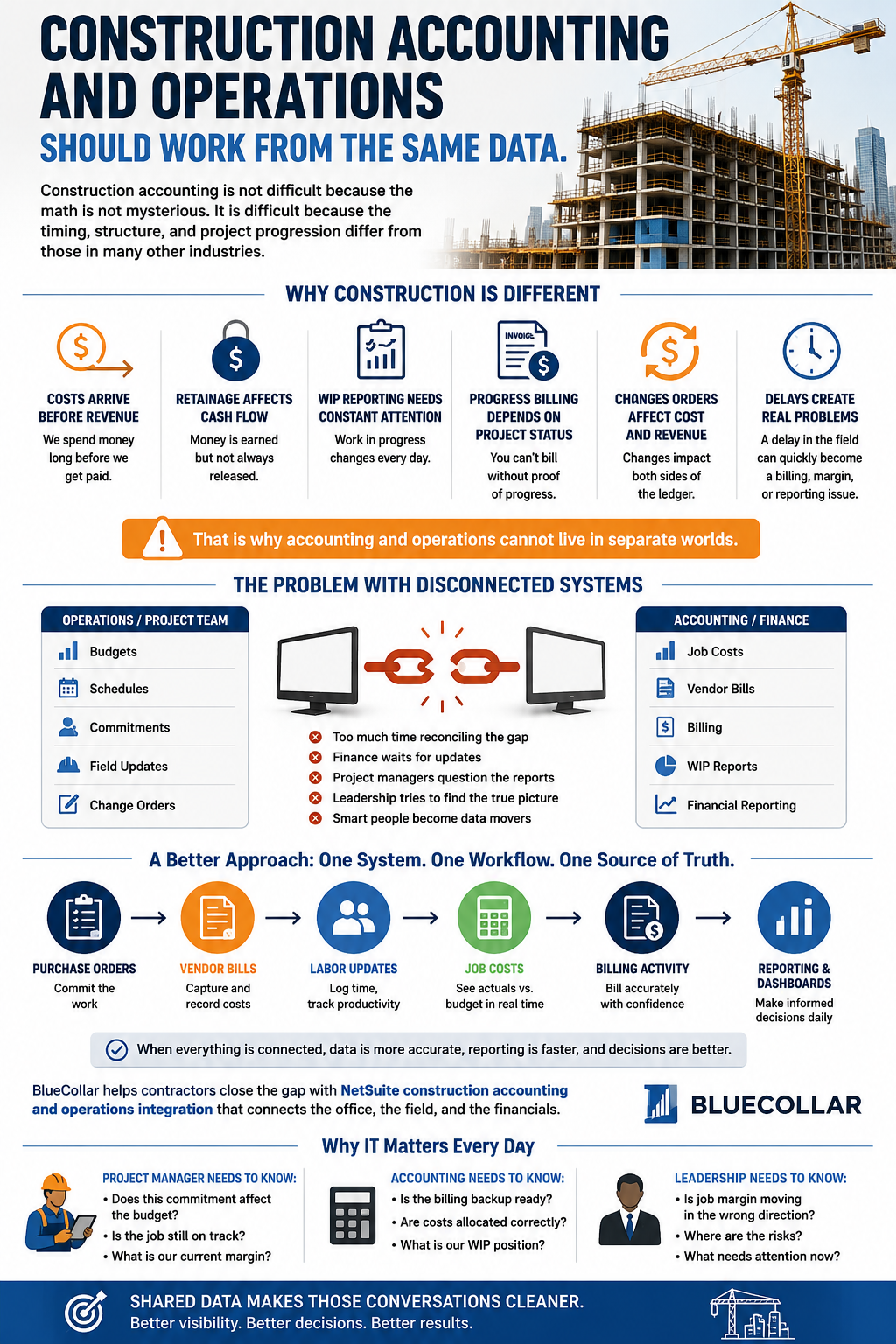
Construction accounting is not difficult because the math is not mysterious. It is difficult because the timing, structure, and project progression differ from those in many other industries.
Costs arrive before revenue. Retainage affects cash flow. WIP reporting needs constant attention. Progress billing depends on project status. Change orders affect both cost and revenue. A delay in the field can quickly become a billing, margin, or reporting problem.
That is why accounting and operations cannot live in separate worlds.
When project teams work in one system and accounting works in another, everyone spends too much time reconciling the gap. Finance waits for updates. Project managers question the reports. Leadership tries to understand the truth between the two systems. The process turns smart people into data movers.
A better approach integrates accounting and operations into a single workflow. BlueCollar has written about how NetSuite construction accounting and operations integration helps contractors reduce those gaps. Purchase orders, vendor bills, labor updates, job costs, billing activity, and reporting all become more useful when they are tied together.
This matters because construction decisions do not happen in neat monthly blocks. They happen every day. A project manager needs to know whether a commitment affects the budget. Accounting needs to know whether the billing backup is ready. Leadership needs to know whether the job margin is moving in the wrong direction.
Shared data makes those conversations cleaner.
Better Scheduling, Billing, And Cash Flow In One Connected Workflow
Construction schedules do not exist in a vacuum. A schedule change can affect labor planning, purchasing, subcontractor timing, billing milestones, cash flow, and customer communication.
If the schedule lives in one tool while the budget lives elsewhere, the company loses context. The date may change, but the financial impact may not show up fast enough. That lag creates risk. A connected ERP environment helps bring scheduling and financial visibility closer together.
Billing has the same problem. Progress billing, milestone billing, retainage, change orders, and contract updates all depend on clean project data. If that data is scattered, invoices slow down. If invoices slow down, cash flow feels the pressure.
That is where construction billing software contractors trust becomes more than an administrative tool. Strong billing workflows help teams connect approved work, job progress, contract terms, documentation, and financial reporting.
A better workflow can help contractors:
- Keep billing closer to actual project progress.
- Reduce manual follow-up between project teams and accounting.
- Track retainage more reliably.
- Connect approved change orders to revenue.
- Improve visibility into cash flow timing.
- Reduce errors in billing, backup, and documentation.
Construction companies do not need additional disconnected systems that create more steps. They need workflows that move information from field activity to financial action without losing the thread.
What BlueCollar Adds To NetSuite For Contractors
NetSuite is powerful, but construction companies need more than access to the platform. They need a construction-specific structure.
That is the difference between having an ERP and having an ERP that actually works for contractors.
BlueCollar helps construction teams shape NetSuite around the realities of job-based work. That includes job costing, billing, project management, cost codes, WIP, change orders, scheduling, reporting, and scalable processes for growing teams.
A generic setup may track financials, but construction companies need deeper alignment between project operations and accounting. They need the system to support how work is sold, planned, bought, performed, billed, and reported. They need project managers to trust the numbers. They need accounting to reduce cleanup. They need leadership to see the business without waiting for someone to rebuild the story.
Contractors need the platform configured around their workflow, not forced into a structure that ignores how jobs actually run.
That can include:
- Construction-specific job costing structures.
- Project templates that match real workflows.
- Billing processes for progress billing, milestones, and change orders.
- WIP and margin reporting.
- Field-to-finance process design.
- Forecasting workflows for project managers.
- Dashboards for leadership.
- Cleaner hand-offs between operations and accounting.
- Scalable controls for growing teams.
The goal is simple. Give construction companies a system they can trust and a process their teams can actually use.
Growing Contractors Need Systems That Scale
Growth can expose every weak spot in a construction company's systems.
A contractor may be able to manage a few projects with spreadsheets, meetings, and heroic effort. Add more projects, more project managers, more vendors, more billing complexity, and more reporting needs, and the pressure builds fast.
At first, the signs can feel small. A report takes longer to prepare. Someone creates a side spreadsheet because the system does not answer the question. Billing needs extra backup. A project manager keeps a separate cost tracker. Leadership asks for a company-wide view, and the team needs days to pull it together.
Those small signs usually point to a bigger issue. The company has outgrown the tools that got it here. But scaling is not only about adding revenue. It is about adding control without adding chaos.
A scalable ERP setup helps standardize how jobs are created, how budgets are tracked, how approvals are handled, how costs are coded, how billing proceeds, and how leadership reviews performance. It gives teams a repeatable foundation instead of forcing every project manager or department to invent their own process.
For growing contractors, that consistency matters. It helps protect margin, reduce confusion, and give leadership better visibility across the business.
Project Management Needs To Connect With Financial Truth
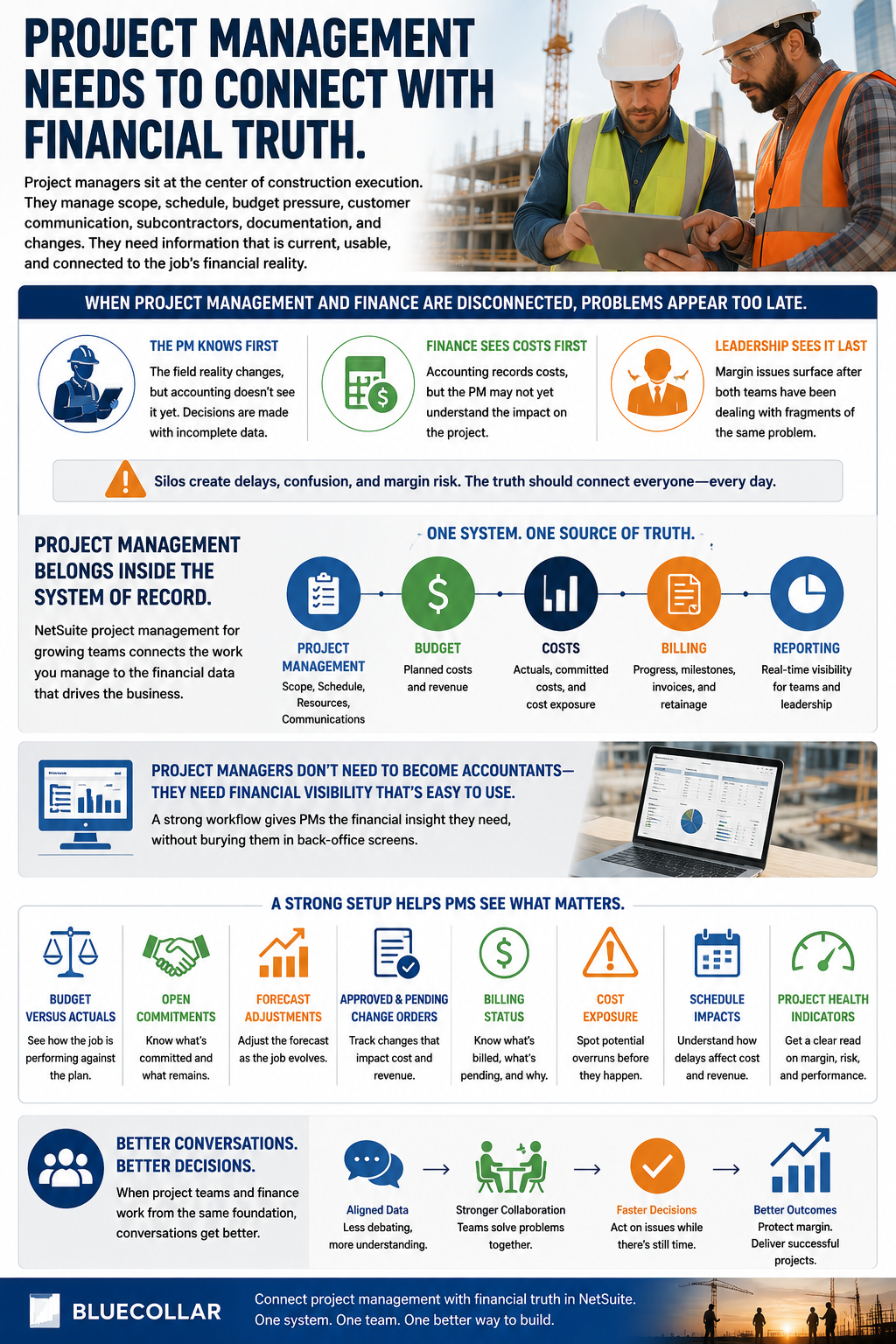
Project managers sit at the center of construction execution. They manage scope, schedule, budget pressure, customer communication, subcontractors, documentation, and changes. They need information that is current, usable, and connected to the job's financial reality.
If project management is separate from financial reporting, problems appear too late.
A PM may know the field reality before accounting sees it. Accounting may see costs before the PM understands the impact. Leadership may see a margin issue after both teams have already been dealing with fragments of the same problem.
That is why NetSuite project management for growing teams is an important part of the broader ERP conversation. Project management should not sit outside the system of record. The work being managed should connect to budget, billing, cost, and reporting data.
This does not mean project managers need to become accountants. It means they need a workflow that gives them useful financial visibility without burying them in back-office screens.
A strong setup helps PMs see:
- Budget versus actuals.
- Open commitments.
- Forecast adjustments.
- Approved and pending change orders.
- Billing status.
- Cost exposure.
- Schedule impacts.
- Project health indicators.
When project teams and finance work from the same foundation, conversations get better. Instead of debating whose spreadsheet is right, teams can focus on what needs to happen next.
Choosing The Right ERP Partner For Construction
Choosing software is only part of the decision. The implementation partner matters because construction ERP depends on workflow design, data structure, adoption, reporting, and practical field-to-office alignment.
A contractor should not have to translate every aspect of the construction process for a partner who only understands generic accounting. The partner needs to understand job costing, billing, retainage, WIP, change orders, cost codes, project visibility, and how field decisions affect financial outcomes.
That is where BlueCollar's focus on construction becomes important. We work with contractors that need NetSuite to support how they already operate while helping them clean up the processes that are slowing them down.
The right partner should help answer questions like:
- How should jobs be structured in NetSuite?
- How should cost codes and phases be organized?
- How should project managers forecast costs?
- How should billing tie back to project progress?
- How should change orders affect budget and revenue?
- What reporting does leadership need every week?
- What should the field update, and what should accounting own?
- How can the system reduce manual cleanup?
A strong ERP partner does not just configure fields. The partner helps design a better operating model.
Build A Cleaner Foundation For Growth
Construction companies do not need more disconnected tools. They need a reliable foundation that connects how projects are managed to how money moves through the business.
That is the real value of ERP for construction industry teams. It gives contractors a cleaner way to manage job costing, billing, scheduling, accounting, purchasing, reporting, and leadership visibility within a single connected system.
For contractors who use or are considering NetSuite, BlueCollar helps make the system practical. We focus on the workflows that construction companies face every day: job cost control, project financial visibility, change order tracking, billing accuracy, WIP reporting, cash flow clarity, and scalable operations.
The result is not just better software. It is a better way to run the business.
When teams stop chasing data, they can start acting on it. When project managers trust the numbers, they can manage work with more confidence. When accounting has cleaner inputs, billing and reporting move faster. When leadership has real visibility, growth becomes easier to manage.
That is the foundation contractors need to scale without losing control.
Streamline Construction Back Office Operations
If your construction company is ready for cleaner job costing, stronger billing workflows, better project visibility, and fewer month-end surprises, BlueCollar can help you build the right NetSuite foundation.
We help contractors connect field teams, project managers, accounting departments, and leadership around a single reliable system that supports how construction work actually gets done.
Start with BlueCollar and see how a better NetSuite workflow can help your team run with more control.
FAQs About ERP For The Construction Industry
What Is ERP For The Construction Industry?
ERP for the construction industry means a connected business system that helps contractors manage financials, job costing, accounting, billing, scheduling, purchasing, project management, reporting, and operations in one place. Instead of using separate tools for each department, construction ERP helps teams work from shared data.
What Is The Best ERP For Construction Companies?
The best ERP for construction companies is the system that fits how contractors manage jobs, costs, billing, changes, and reporting. NetSuite can be a strong fit when configured correctly for construction workflows, and BlueCollar helps contractors shape NetSuite to real job-based operations.
How Does ERP Help Construction Job Costing?
ERP helps with construction job costing by consolidating budgets, committed costs, actual costs, labor, materials, subcontractors, equipment, and change orders into a single system. That gives project managers and leadership better visibility into job performance while the work is still active.
Can NetSuite Be Used For Construction Management?
Yes, NetSuite can be used for construction management when it is configured to align with how contractors operate. With the right setup, it can support project financials, job costing, billing, purchasing, WIP reporting, scheduling visibility, and leadership dashboards.
Why Do Contractors Outgrow QuickBooks?
Contractors often outgrow QuickBooks when job volume increases, reporting becomes harder, billing requires more manual backup, and project teams need stronger cost visibility. QuickBooks may work early on, but growing contractors usually need a more connected system for project and financial control.
How Does Construction ERP Improve Billing?
Construction ERP improves billing by connecting contract values, approved change orders, project progress, retainage, cost data, and billing workflows. That helps accounting teams reduce delays, improve invoice support, and keep billing more closely aligned with the actual work being performed.
What Features Should Construction ERP Software Include?
Construction ERP software should include job costing, project accounting, billing workflows, purchasing controls, change order tracking, WIP reporting, dashboards, scheduling visibility, field-to-office updates, and scalable financial reporting. The system should support both project teams and accounting teams.
Does ERP Help With Construction Cash Flow?
Yes, ERP can help with construction cash flow by improving billing accuracy, reducing reporting delays, tracking retainage, linking project progress to invoices, and providing leadership with better visibility into costs, revenue, and timing across active jobs.
How Can BlueCollar Help With NetSuite For Construction?
BlueCollar helps construction companies configure NetSuite for contractor workflows, including job costing, billing, WIP reporting, change orders, project management, accounting integration, scheduling visibility, and scalable reporting. The goal is to make NetSuite practical for how construction companies actually operate.