NetSuite ERP Cost: What Construction Firms Should Know Before They Buy

Most construction firms don't start an ERP search because they want another software bill. They start because something inside the business is getting harder to control. Job costs are taking too long to verify, reports are stuck in spreadsheets, change orders are buried in email, and leadership can't always see what's happening across projects until the damage is already done.
That's why the conversation around NetSuite ERP cost can't be reduced to a single number. The real question is what your company needs the system to do, how complex your operations are, and how much manual work you're trying to remove from the business. A contractor running a few local crews has a different setup than a multi-entity firm managing projects across states, vendors, subcontractors, inventory, and field teams.
BlueCollar works with companies that need more than generic software. Our focus is on helping project-based businesses build cleaner workflows, better reporting, and stronger visibility through NetSuite. This is because a construction ERP is about control, not just accounting.
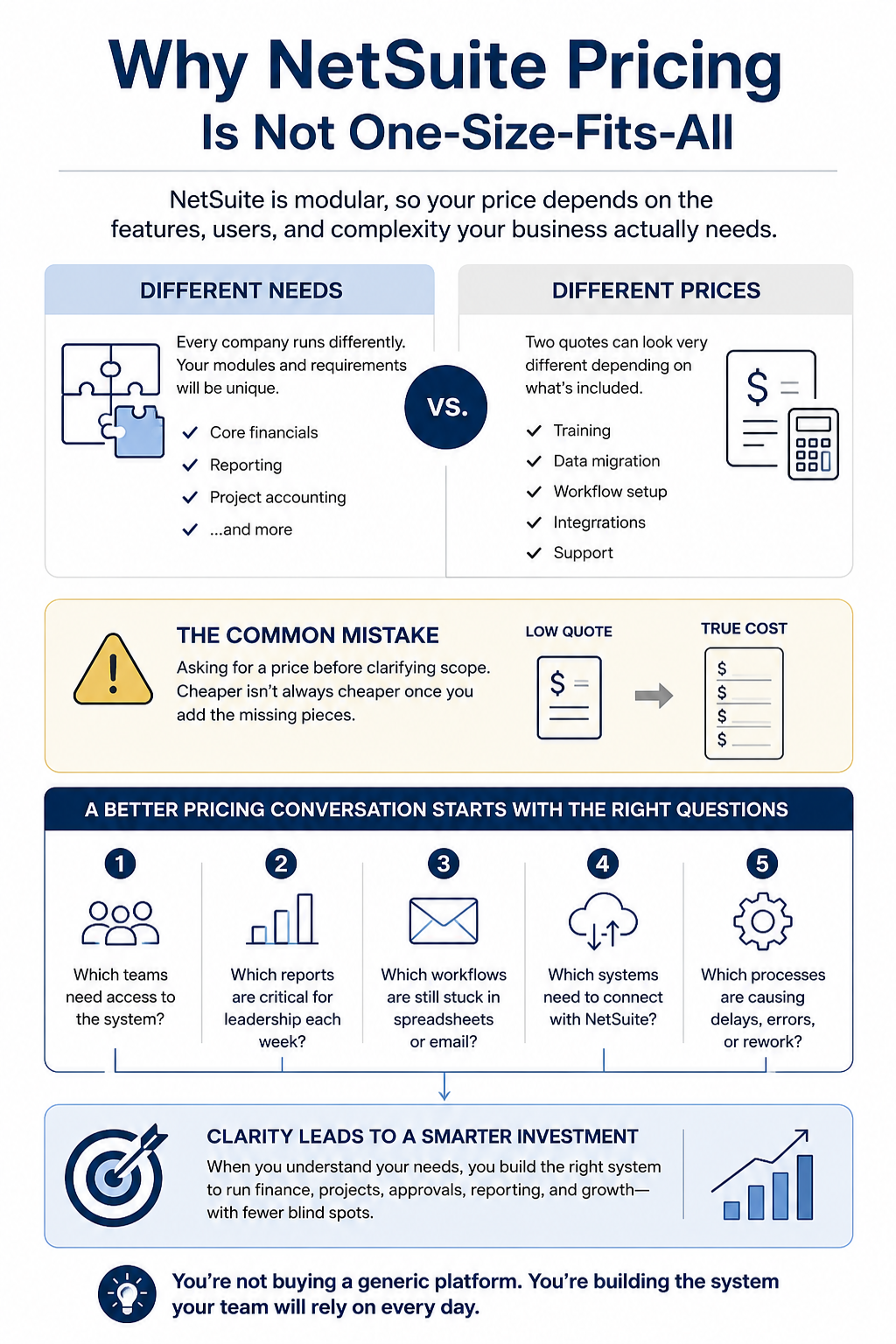
Why NetSuite Pricing Is Not One-Size-Fits-All
NetSuite pricing changes from company to company because the system is modular. That flexibility is a strength, but it also means pricing depends on what your team actually needs. Some businesses need core financials, reporting, and project accounting. Others need procurement, inventory, CRM, custom dashboards, payroll connections, approval workflows, field updates, and deeper integrations with the tools their teams already use.
The mistake many companies make is asking for a price before they've clarified the scope. That approach usually leads to confusion because two quotes can look completely different on paper. One may include training, migration, and workflow setup, while another may only cover software access and a light implementation. The cheaper option isn't always cheaper once you add the missing pieces.
A better pricing conversation starts with operational questions:
- Which teams need access to the system?
- Which reports are critical for leadership each week?
- Which workflows are still stuck in spreadsheets or email?
- Which systems need to connect with NetSuite?
- Which processes are causing delays, errors, or rework?
Once those questions are answered, the investment becomes easier to understand. You're not buying a generic platform. You're building the system your team will rely on to run finance, projects, approvals, reporting, and growth with fewer blind spots.
The Main Pieces That Affect The Final Investment
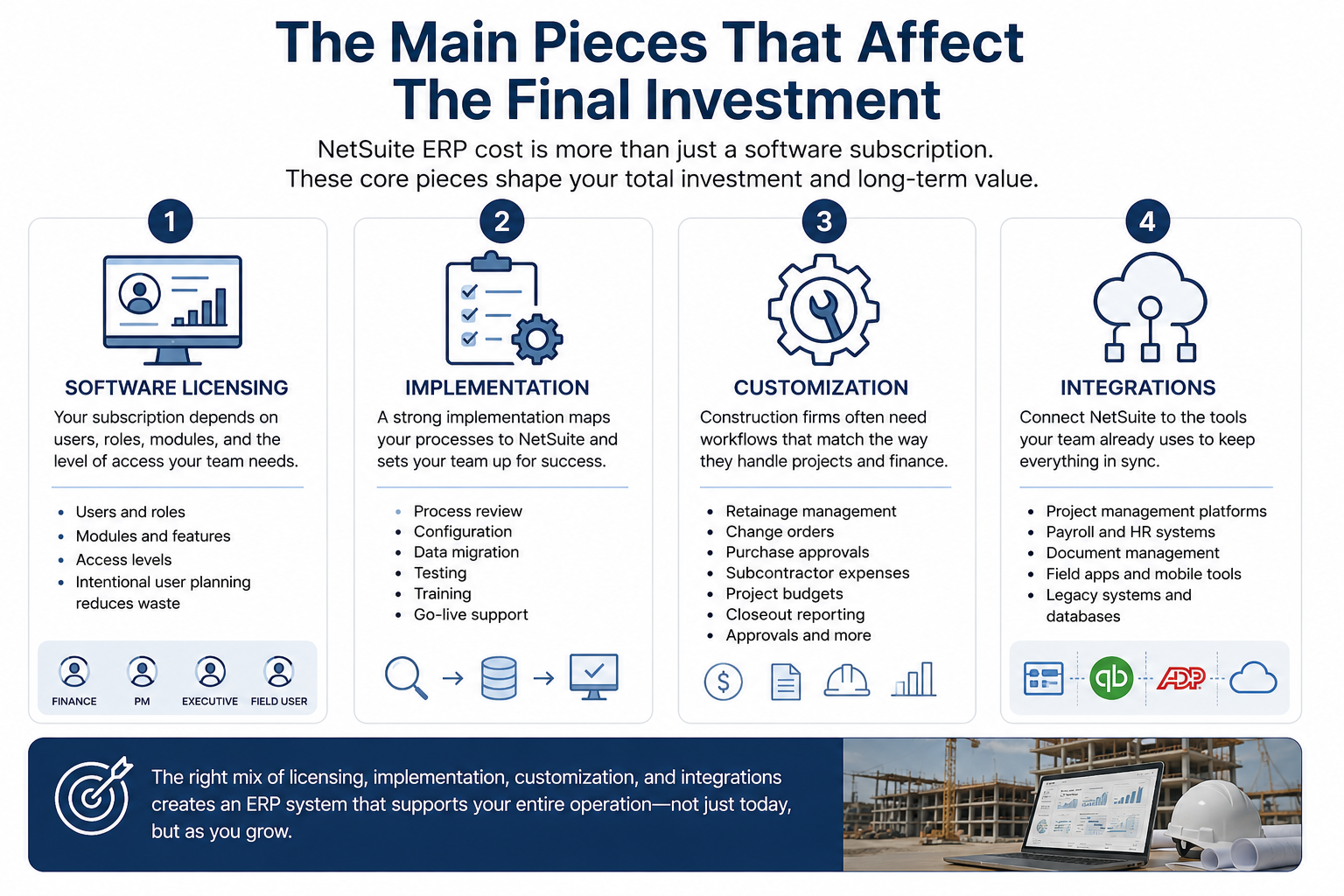
The biggest cost drivers usually fall into a few clear categories. Software licensing is the first piece. Your subscription depends on users, roles, modules, and the level of access your team needs. A finance leader, project manager, executive, and field user may not all require the same setup, so user planning should be intentional instead of rushed.
Implementation is the second major piece. This includes process review, configuration, data migration, testing, training, and go-live support. A strong implementation doesn't just turn features on. It maps the way your business works and configures NetSuite around real workflows, from job costing and billing to approvals and reporting.
Customization can also affect the final scope. Construction companies often need workflows that match how they handle retainage, change orders, purchase approvals, subcontractor expenses, project budgets, and closeout reporting. Those details are exactly where ERP either becomes useful or becomes another system people work around.
Integrations may also be part of the investment. Many companies need NetSuite to connect with project management platforms, payroll tools, document systems, field apps, or legacy databases. The right ERP setup should support the whole operation, not sit off to the side.
What Construction Companies Should Budget For
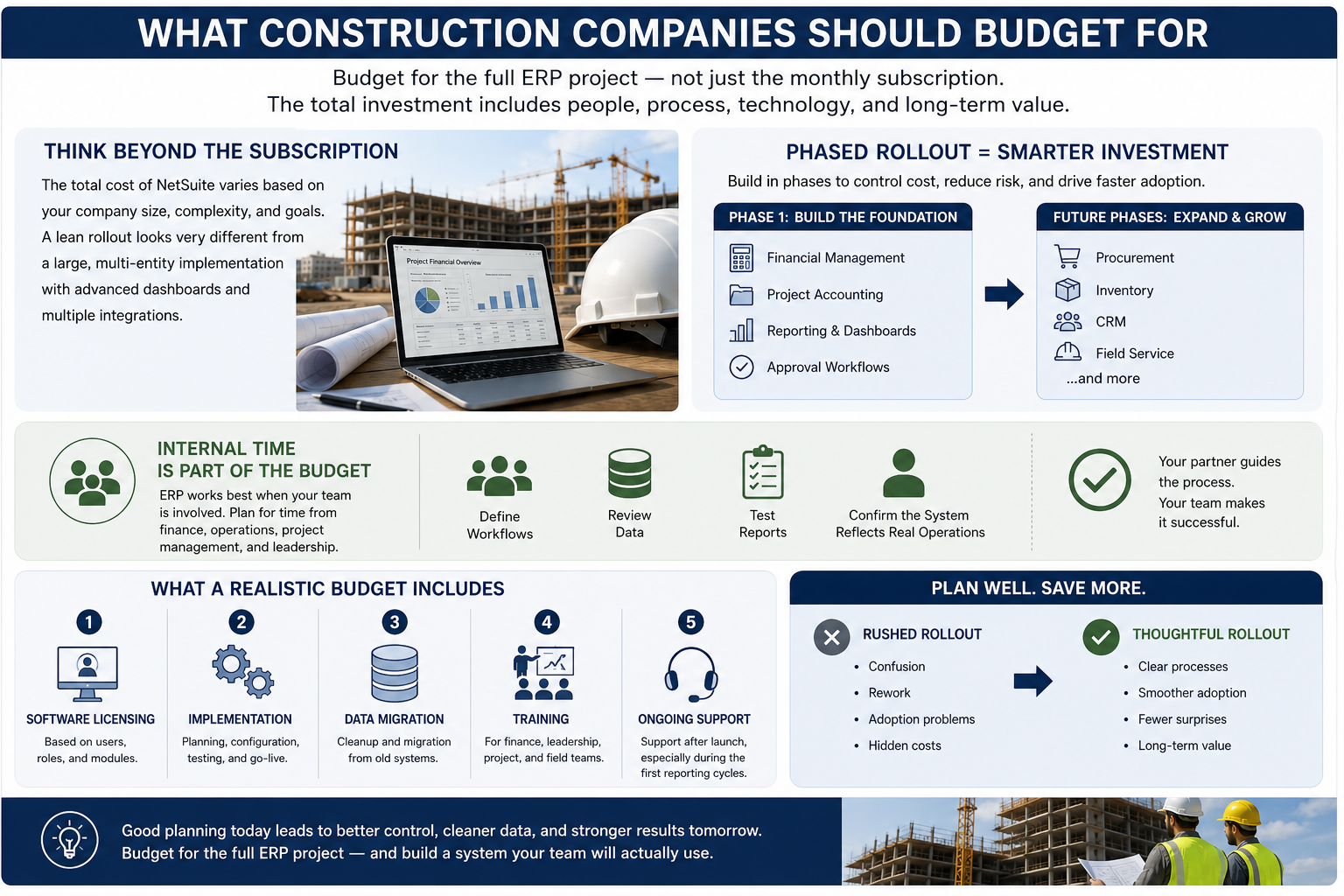
A construction firm should budget for the full ERP project, not just the monthly subscription. That means thinking about licensing, setup, migration, training, support, and future improvements. The number can vary widely because a lean rollout with core functionality looks very different from a larger build with multiple entities, advanced dashboards, and several integrations.
The smarter move is to separate needs into phases. Phase one may focus on financials, project accounting, reporting, and approval workflows. Later phases can add modules such as procurement, inventory, CRM, field service, or others after the team has adopted the foundation. This keeps the project focused and gives the business a clearer path forward.
Budgeting should also include the internal time required from your team. ERP implementation works best when finance, operations, project management, and leadership are involved. Your partner can guide the process, but your team still needs to help define workflows, review data, test reports, and confirm that the system reflects how the business actually runs.
A realistic budget should account for:
- Software licensing based on users and modules.
- Implementation planning, configuration, and testing.
- Data cleanup and migration from old systems.
- Training for finance, leadership, project, and field teams.
- Support after launch, especially during the first few reporting cycles.
This is where good planning saves money. A rushed rollout can create confusion, rework, and adoption problems. A thoughtful rollout helps the system become part of daily operations instead of another tool nobody fully trusts.
The Difference Between Cheap Software And The Right ERP Investment
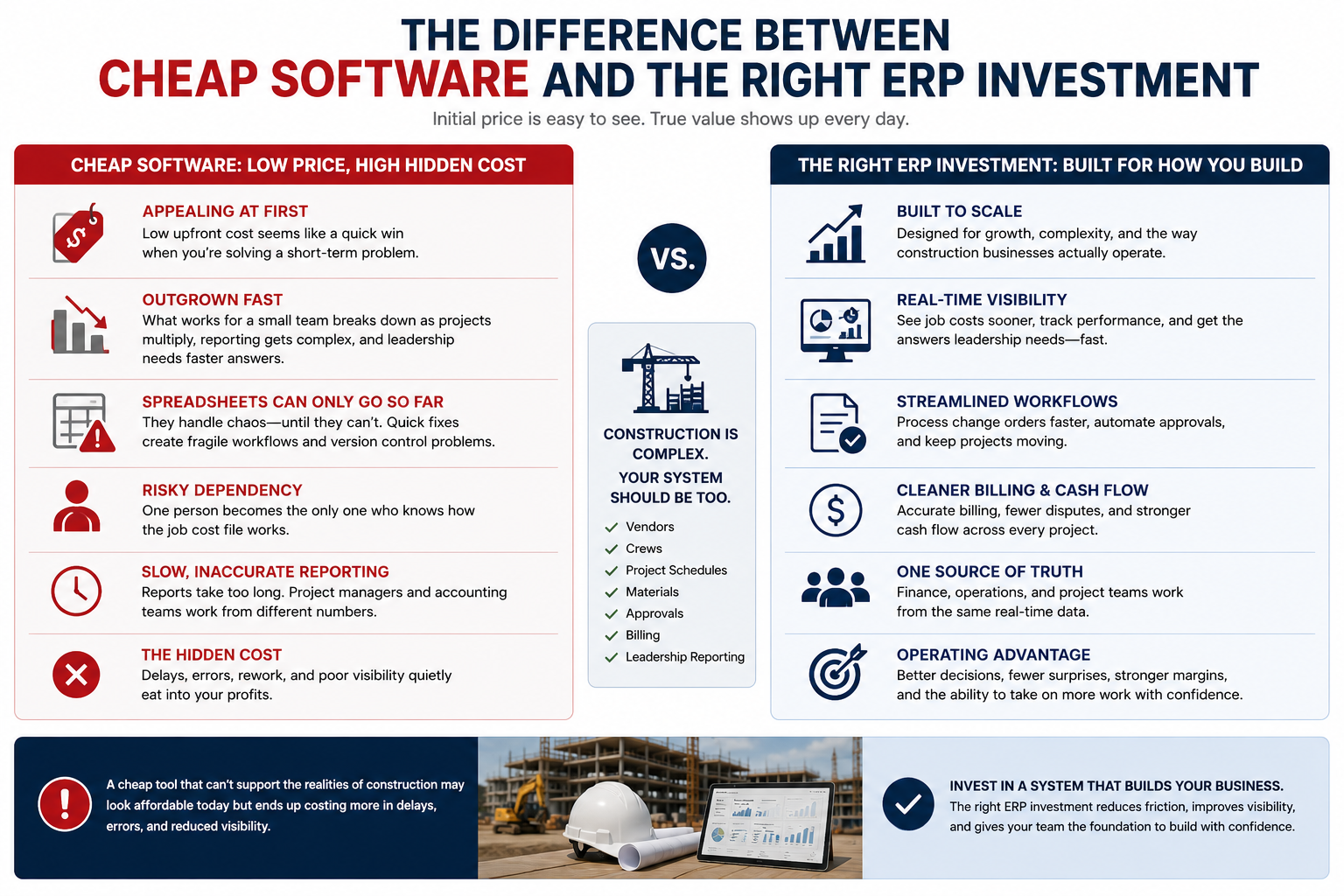
Low-cost software can look appealing at first, especially if the business is trying to solve a short-term pain point. The problem is that construction companies often outgrow basic systems fast. What worked for a smaller team may break down as projects multiply, reporting becomes more complex, and leadership needs faster answers.
Spreadsheets can handle a surprising amount of chaos until they can't. Quick fixes turn into fragile workflows. Someone becomes the only person who knows how the job cost file works. Reports take too long to pull. Project managers and accounting teams work from different numbers. At that point, the hidden cost of staying with disconnected tools becomes obvious.
The right ERP investment should reduce friction across the business. It should help your team see job costs sooner, process change orders faster, clean up billing, and understand project performance without waiting for someone to manually stitch reports together. That's not just a software benefit. It's an operating advantage.
Construction firms need systems built for moving parts: vendors, crews, project schedules, materials, approvals, billing, and leadership reporting. A cheap tool that can't support those realities may end up costing more due to delays, errors, and reduced visibility.
How Implementation Scope Changes The Price
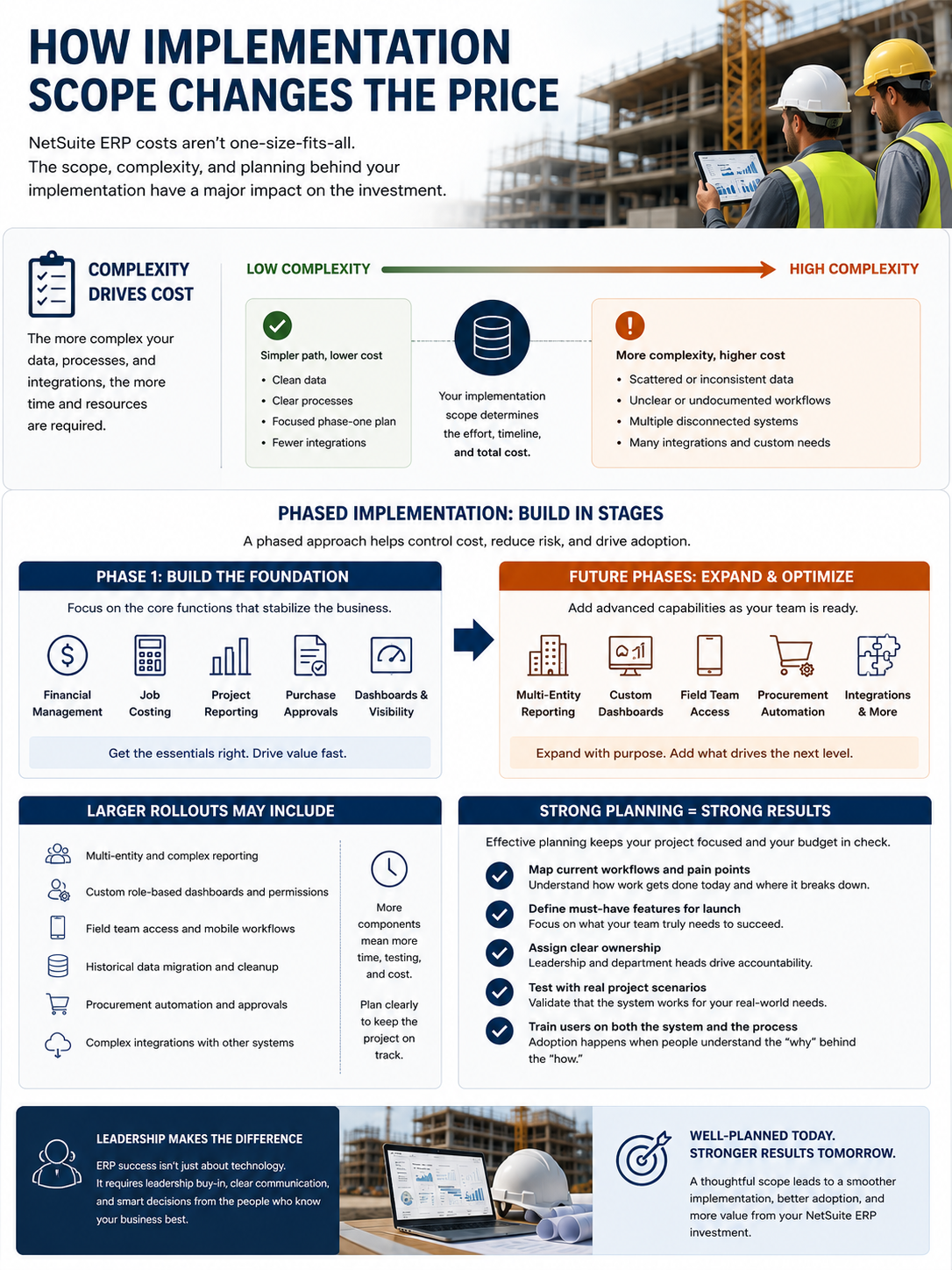
Implementation scope has a major effect on NetSuite ERP costs because each business brings a different level of complexity. A company with clean data, clear processes, and a focused phase-one plan will usually have a simpler path than a company with years of scattered records, unclear workflows, and several disconnected systems.
A phased implementation can be a strong option for many construction companies. The first phase can focus on the core functions needed to stabilize the business. That often includes financial management, job costing, project reporting, purchase approvals, and dashboards. Once the foundation is working, the business can expand into additional workflows.
A larger rollout may include more advanced needs. Multi-entity reporting, custom role-based dashboards, field team access, historical data migration, procurement automation, and complex integrations can all add time and cost. None of these is a bad thing. They simply need to be planned clearly so the project doesn't drift.
Strong implementation planning usually includes:
- A clear map of current workflows and pain points.
- A defined list of must-have features for launch.
- Clean ownership from leadership and department heads.
- Testing that reflects real project scenarios.
- Training that helps users understand both the system and the process.
Leadership involvement is especially important because ERP success isn't only technical. It requires buy-in, communication, and practical decisions from the people who understand how the business runs.
How BlueCollar Helps Companies Plan Smarter
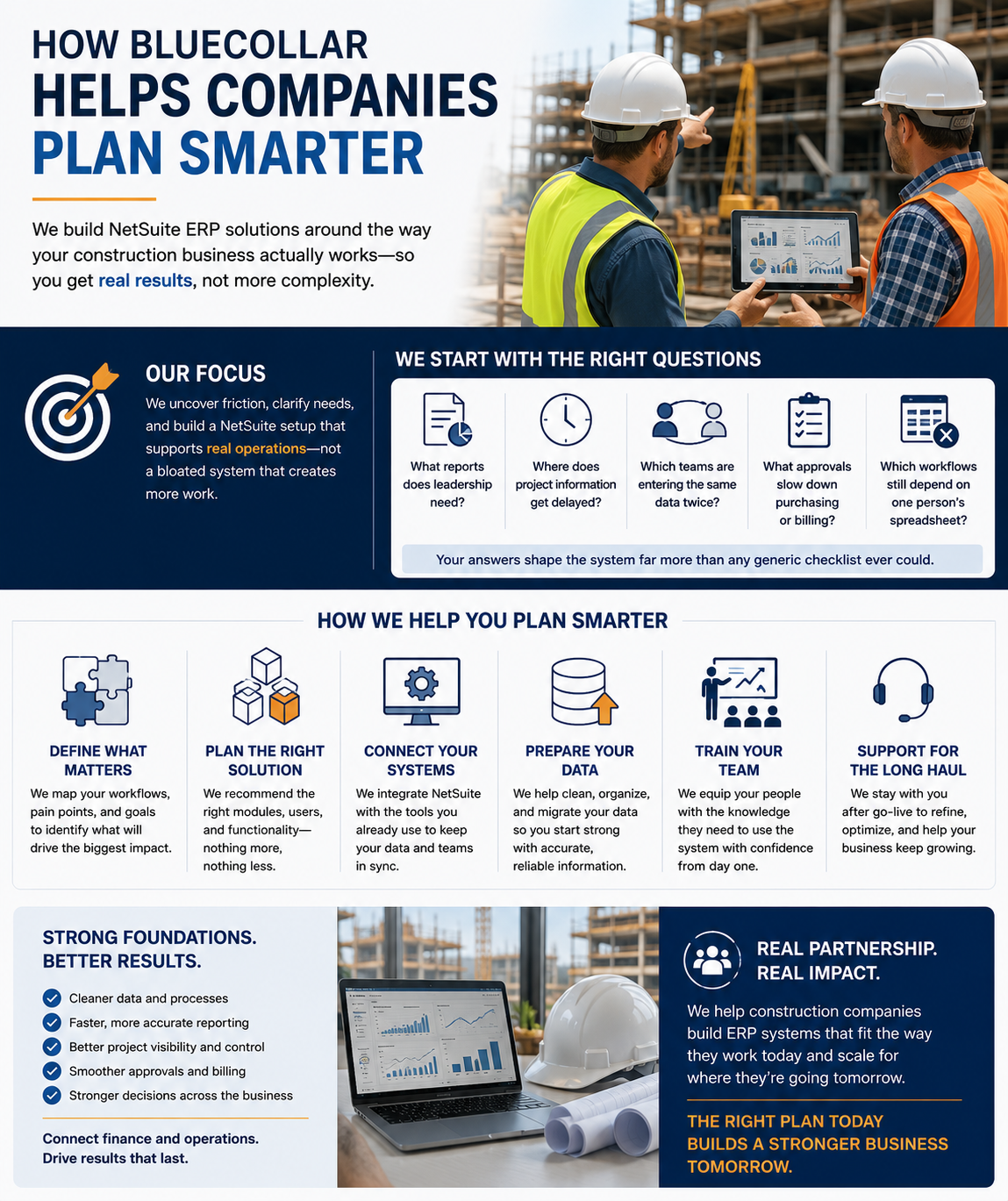
BlueCollar doesn't look at ERP as a box-checking exercise. We look at how your company works, where the friction sits, and what your team needs to see faster. The goal is to help you build a NetSuite setup that supports real operations, not a bloated system that sounds impressive during a demo and frustrates everyone after launch.
That starts with asking the right questions. What reports does leadership need? Where does project information get delayed? Which teams are entering the same data twice? What approvals slow down purchasing or billing? Which workflows are still dependent on one person's spreadsheet? These answers shape the system far more than a generic software checklist ever could.
Our role is to help companies think through the practical pieces before they commit. That includes modules, users, integrations, data migration, training, and long-term support. It also includes helping teams avoid unnecessary complexity. More features are not always better on day one. The better goal is the right foundation, followed by smart expansion.
This is the kind of ERP thinking behind our broader project and construction content, including our ERP for construction industry guide. Construction companies need systems that connect finance and operations, not tools that keep departments working in separate lanes.
Common Mistakes Companies Make While Comparing Prices
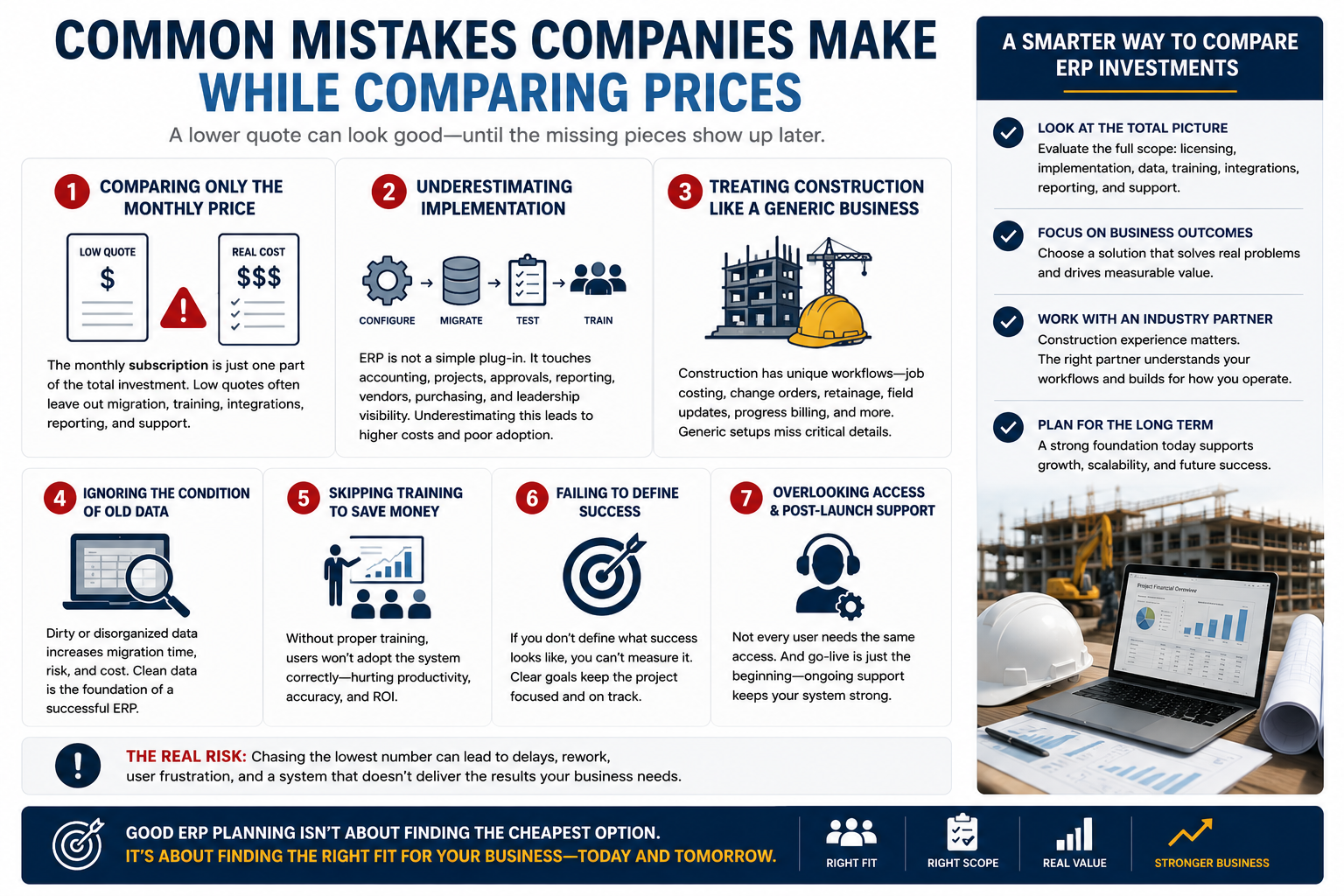
The first mistake is comparing quotes only by monthly subscription cost. That number matters, but it doesn't tell the whole story. A low quote may leave out data migration, training, integrations, reporting, or support. A higher quote may include more of the work needed to get the system running correctly.
The second mistake is underestimating implementation. ERP is not a simple plug-in. It touches accounting, projects, approvals, reporting, vendor management, purchasing, and leadership visibility. If those workflows aren't mapped carefully, the system may technically launch but still fail to make daily work easier.
Another mistake is treating construction like a generic business model. Construction companies deal with job costing, change orders, retainage, subcontractors, field updates, progress billing, and project-based margins. A partner that doesn't understand those needs may configure the system in a way that misses the details your team depends on.
Other pricing mistakes include:
- Ignoring the condition of old data before migration.
- Skipping training to lower the upfront project cost.
- Failing to define what success should look like.
- Choosing software before clarifying operational problems.
- Assuming every user needs the same level of access.
- Forgetting to plan for support after launch.
Good ERP planning doesn't chase the lowest number. It looks for the clearest fit between cost, scope, business need, and long-term value.
What ROI Can Look Like After NetSuite Is Set Up Well
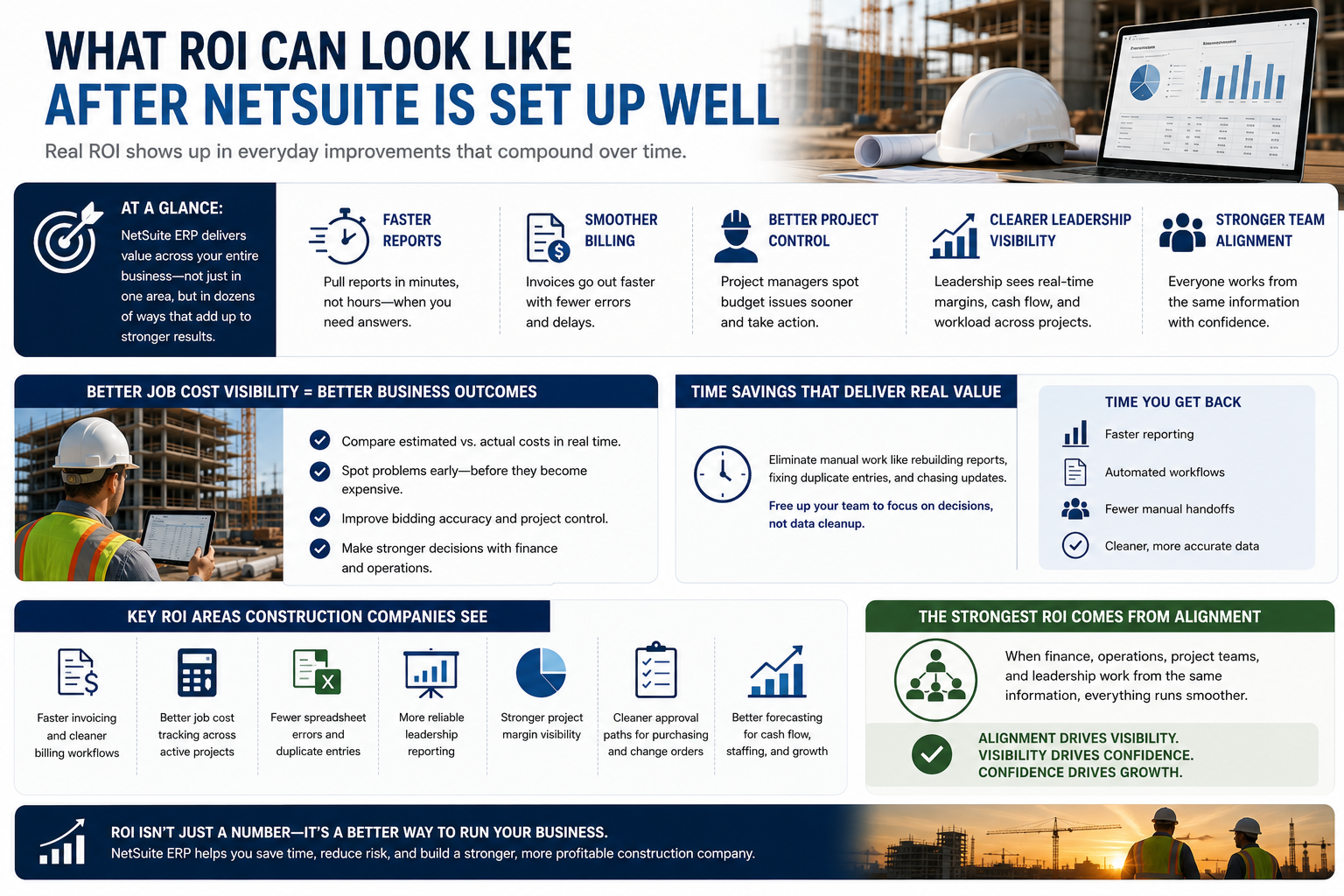
An ERP return doesn't always show up as a single dramatic line item. More often, it appears through dozens of operational improvements that compound over time. Reports get pulled faster. Billing moves with fewer delays. Project managers see budget issues sooner. Leadership gets cleaner visibility into margins, cash flow, and workload.
For construction companies, better job cost visibility can be one of the biggest gains. When estimated costs and actual costs are easier to compare, teams can spot issues before they become expensive surprises. That supports better bidding, better project control, and stronger conversations between finance and operations.
Time savings also matter. If your team spends hours each week rebuilding reports, correcting duplicate entries, or chasing updates, that time has a real cost. A properly configured ERP can reduce manual work and give people more time to focus on decisions instead of cleanup.
Possible ROI areas include:
- Faster invoicing and cleaner billing workflows.
- Better job cost tracking across active projects.
- Fewer spreadsheet errors and duplicate entries.
- More reliable leadership reporting.
- Stronger project margin visibility.
- Cleaner approval paths for purchasing and change orders.
- Better forecasting for cash flow, staffing, and growth.
The strongest return usually comes from alignment. Finance, operations, project teams, and leadership need to work from the same information. Once that happens, the business can move with more confidence.
Talk With BlueCollar About Your NetSuite Plan
If your team is trying to understand what NetSuite might cost, the best next step is a real conversation about your business. Guessing from generic pricing ranges won't tell you what your company needs, which modules make sense, or how much implementation support will be required.
BlueCollar can help you review your current systems, project workflows, reporting needs, and operational gaps. From there, we can help you think through the right scope, rollout path, and support model for your team. The goal isn't to sell you more software than you need. The goal is to help you build a system that actually fits.
Schedule a Demo with BlueCollar Today to start planning a smarter NetSuite ERP path for your construction business.
Frequently Asked Questions About NetSuite ERP Cost
How Much Does NetSuite ERP Cost?
The final investment depends on users, modules, implementation scope, customization, integrations, training, and ongoing support. That's why a reliable estimate usually requires a review of your business processes first. A small company with core accounting and reporting needs will have a different scope than a larger contractor with multiple entities, field workflows, procurement, and advanced dashboards. The better question is what the system needs to solve and how much value it can return once it's set up correctly.
What Affects NetSuite ERP Cost The Most?
The biggest factors are usually licensing, implementation complexity, required modules, data migration, integrations, and support. Construction companies may also need job costing, approval workflows, project reporting, retainage support, purchasing controls, and role-based dashboards. Each added requirement can affect the scope, but that doesn't mean every company needs everything at once. A clear phase-one plan can keep the project focused while leaving room to expand later.
Is NetSuite Worth The Cost For Construction Companies?
NetSuite can be worth the investment for construction companies that need stronger financial control, cleaner reporting, and better project visibility. If your team is already struggling with spreadsheets, disconnected systems, delayed reports, or unclear job costs, ERP can help create a more reliable operating structure. The value often comes from faster decisions, fewer errors, tighter project controls, and better visibility across finance and operations. The key is making sure the system is configured around your actual workflows.
Can NetSuite Replace QuickBooks And Spreadsheets?
Yes, many growing companies move from QuickBooks and spreadsheets to NetSuite because they need a more connected system. QuickBooks may work well early on, but it can become limiting as projects, entities, approvals, and reporting needs become more complex. Spreadsheets can fill gaps for a while, but they often create version control issues, manual work, and reporting delays. NetSuite gives companies a stronger foundation for financials, projects, reporting, and operational control.
Does Implementation Increase The Total Cost?
Yes, implementation is a major part of the total investment. It includes process mapping, system configuration, data migration, report setup, testing, training, and launch support. Skipping or over-shrinking implementation can create problems after go-live because the system may not align with how your team works. A good implementation helps NetSuite become a reliable business system instead of just another software login.
Can Companies Start Small With NetSuite?
Many companies can start with a focused rollout and expand over time. A first phase may include financials, project accounting, dashboards, and core reporting. Later phases can add procurement, inventory, CRM, field workflows, or additional integrations. This approach can make the project easier to manage while still building toward a more complete ERP environment.
How Long Does It Take To Implement NetSuite?
Timing depends on company size, data condition, process complexity, integrations, and team availability. A focused implementation can move faster than a large multi-entity rollout with custom workflows and several connected systems. The best timelines come from clear planning, strong internal ownership, and realistic testing. Rushing the process can create confusion, so it's better to launch a system your team trusts than to chase speed at the expense of quality.
Do Construction Companies Need Custom NetSuite Workflows?
Many construction companies benefit from custom workflows because their operations are project-based and detail-heavy. Standard accounting workflows may not fully support job costing, change orders, retainage, subcontractor approvals, and project-level reporting. Custom workflows can help the system reflect the way your company actually manages work. The goal is not customization for its own sake. The goal is to make daily operations cleaner, faster, and more reliable.
How Can BlueCollar Help Estimate NetSuite ERP Cost?
BlueCollar can help your team review workflows, software needs, reporting requirements, integrations, and operational goals before you commit to a plan. That process helps define the right modules, users, implementation scope, and support needs. It also helps prevent overspending on features you don't need right away or underplanning the pieces that are critical to success. If you're ready to get a clearer number, BlueCollar can help you build a practical ERP plan that fits how your business actually runs.