
What Is a WIP Report in Construction? A Practical Guide
A construction project can appear profitable on paper while its financial position tells a different story. Labor costs may be increasing faster than expected, subcontractor commitments may not be fully reflected in actual costs, and billing can move ahead of or fall behind the work completed.
These conditions make it difficult for construction companies to understand how much revenue a project has earned, what it will cost to finish, and whether the original profit expectations are still realistic. A work-in-progress report, commonly called a WIP report, helps contractors answer those questions while projects are still underway.
What Is a WIP Report in Construction?
A WIP report in construction is a financial report that tracks the progress, costs, billings, and estimated profitability of active construction projects. It brings together the financial information needed to evaluate where a job stands and what the contractor expects to earn when the work is complete.
Unlike a basic job-cost report, a construction WIP report goes beyond recorded expenses. It considers the project's contract value, estimated total costs, costs incurred to date, projected cost to complete, revenue earned, and amounts billed to the customer.
Construction companies commonly use WIP reporting to support:
- Project profitability analysis
- Percentage-of-completion calculations
- Revenue recognition reviews
- Overbilling and underbilling analysis
- Cost-to-complete forecasting
- Financial reporting and management decisions
A WIP report is particularly valuable for contractors managing multiple jobs with different schedules, billing arrangements, and cost structures. It helps finance and operations work from a more consistent understanding of each project's financial position.
Why Contractors Need WIP Reporting
Construction financial performance cannot always be determined from invoices, cash receipts, or the general ledger alone. A contractor might receive a substantial progress payment before completing the corresponding work, while another project may incur high costs before the next billing milestone.
Neither situation automatically indicates that a project is profitable or unprofitable. Leadership needs to understand the relationship between actual progress, expected final costs, earned revenue, and billings.
Consider a commercial contractor managing 25 active projects. Some jobs are approaching completion, others are waiting for materials, and several have pending change orders that could affect expected revenue or remaining costs.
Without consistent WIP reporting, the controller may struggle to determine which projects meet profit expectations and which need closer attention. Stronger construction accounting in NetSuite helps create the financial foundation for reviewing costs, budgets, billing, and project performance together.
What Information Goes Into a Construction WIP Report?
A useful construction WIP report combines contract information, project cost data, forecasts, and billing activity. Although individual reporting formats vary, several financial elements are especially important.
| WIP report component | What it tells the contractor |
|---|---|
| Original contract value | The initial agreed contract amount |
| Approved change orders | Authorized adjustments to contract value |
| Revised contract value | Current contract amount, including approved changes |
| Original and revised budget | Planned and updated project costs |
| Actual costs to date | Costs incurred through the reporting date |
| Estimated cost to complete | Expected additional costs required to finish |
| Estimated total cost | Current forecast of total project cost |
| Percentage complete | Estimated financial progress on the job |
| Earned revenue to date | Revenue associated with completed performance under the applicable accounting method |
| Billings to date | Amounts invoiced to the customer |
| Overbilling or underbilling | Difference between billings and earned revenue |
| Estimated final gross profit | Expected contract revenue less projected total costs |
These figures work together, not independently. For example, actual costs may be accurate, but an outdated estimate of remaining subcontractor expenses can still make projected profitability misleading.
A reliable report therefore depends on both accounting records and the operational judgment of the people managing the work.
How to Calculate WIP in Construction
Many contractors use a cost-to-cost percentage-of-completion method as part of their WIP analysis, where appropriate under their revenue-recognition policies. This method compares actual costs incurred with the current estimate of total project costs.
The calculations are straightforward in principle, but their accuracy depends heavily on input quality.
Step 1: Determine the Revised Contract Value
The revised contract value reflects the original contract plus approved changes affecting the contract amount. Pending or disputed change orders require separate consideration and should not automatically be treated as approved revenue.
Step 2: Calculate Estimated Total Project Cost
Estimated total cost includes costs already incurred and the current forecast of what it will cost to finish the job.
Estimated Total Cost = Costs to Date + Cost to Complete
Step 3: Calculate Percentage Complete
Under the illustrative cost-to-cost approach:
Percent Complete = Costs to Date ÷ Estimated Total Cost × 100
Step 4: Calculate Earned Revenue
For a simplified example using cost-to-cost progress:
Earned Revenue = Contract Value × Percent Complete
$2,000,000 × 50% = $1,000,000
Actual revenue recognition may require additional adjustments depending on the contract and applicable accounting policies.
Step 5: Compare Revenue Earned With Billings
Comparing earned revenue with customer billings helps identify the project's billing position. This calculation is an important part of understanding whether billing is ahead of or behind recognized progress.
Construction WIP Report Example
Consider a contractor working on a commercial construction project with the following financial information.
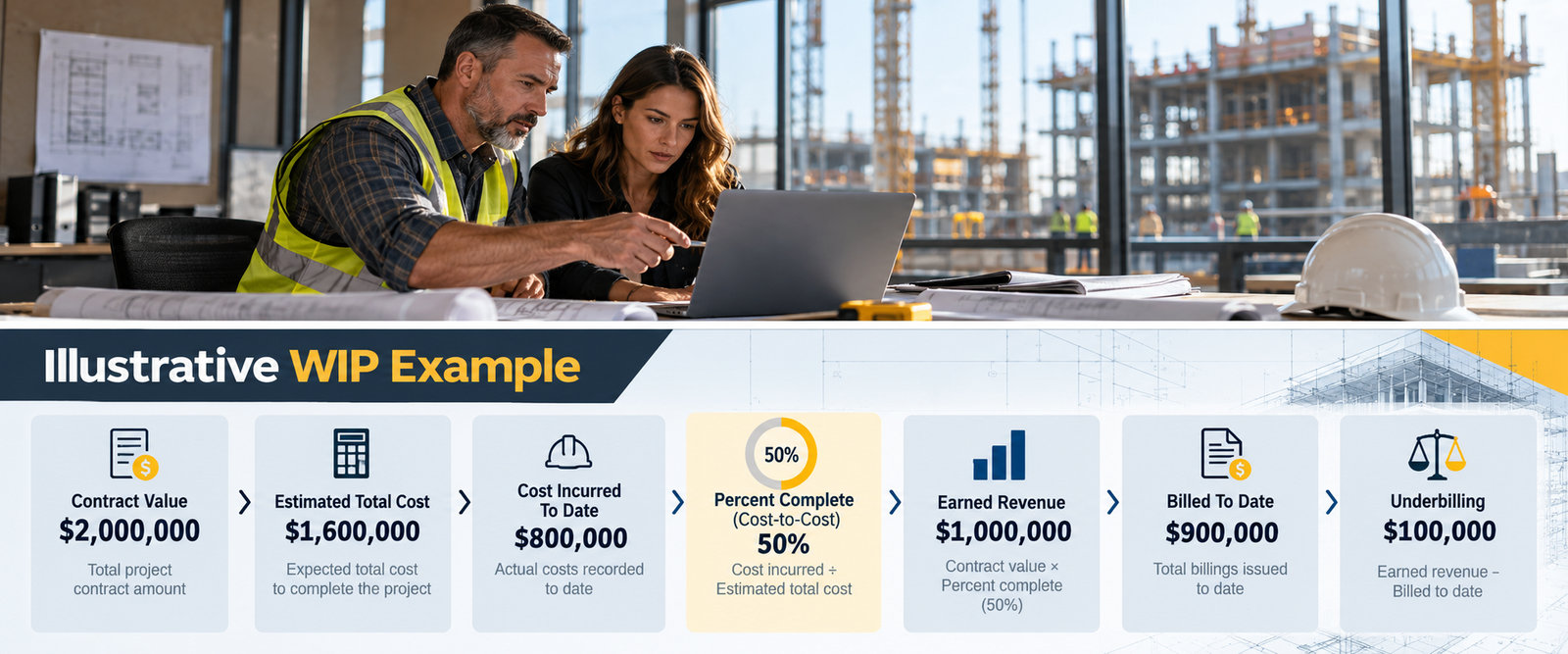
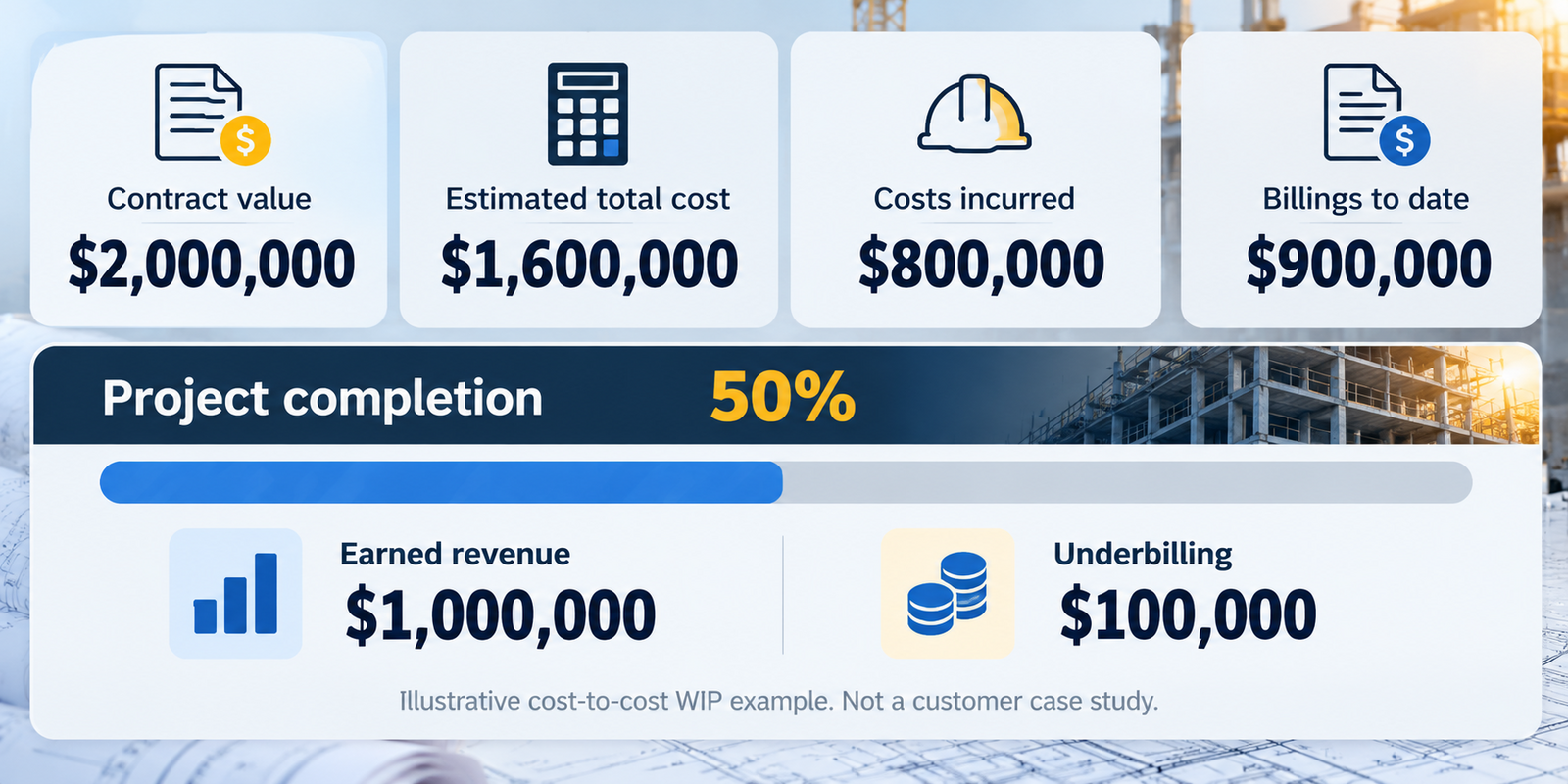
With $800,000 in costs incurred against $1.6 million in estimated total costs, the job is 50% complete under the simplified cost-to-cost calculation. That produces $1 million in earned revenue on a $2 million contract.
The contractor has billed $900,000, leaving a $100,000 underbilling position. The project's expected final gross profit is $400,000, assuming the current estimates remain accurate.
Understanding Overbilling and Underbilling in Construction
Overbilling and underbilling describe differences between amounts invoiced and revenue recognized on a construction project. These differences can occur because contract billing schedules do not always align with the timing of work performed.
Overbilling occurs when cumulative billings exceed earned revenue. A contractor may bill in advance to support mobilization, material procurement, or other contract requirements, without having earned the entire billed amount.
Underbilling occurs when earned revenue exceeds cumulative billings. This can happen when work progresses faster than the billing schedule, invoices are delayed, or certain project costs and completed work have not yet been reflected in billing.
Neither condition automatically establishes whether a project is financially healthy. A meaningful WIP review considers the size, cause, timing, and expected resolution of the billing difference.
How WIP Reporting Reveals Project Financial Risks
One of the most important uses of a WIP report is evaluating whether a project's expected final profit has changed. A job may remain busy, generate regular invoices, and show consistent activity while its projected margin declines.
Suppose the estimated total cost of the example project increases from $1.6 million to $1.8 million after the project manager revises the remaining labor and subcontractor forecasts. Assuming the contract value remains $2 million, expected gross profit falls from $400,000 to $200,000.
That change affects both the project's expected outcome and its measured progress under a cost-to-cost model. If the revised estimate isn't reflected in WIP, finance may keep relying on assumptions that no longer match current job conditions.
Consistent construction project management in NetSuite can help keep project information and financial review closer together. The objective is to ensure that operational changes affecting expected costs are communicated and evaluated before they become unexpected month-end adjustments.
Common Construction WIP Reporting Problems
Even experienced contractors can struggle to keep WIP reports consistent across a growing portfolio. The biggest challenges often involve how project information moves between operations and finance.
Outdated cost-to-complete forecasts. Actual costs may be current while the remaining-cost estimate still reflects assumptions from several weeks earlier. That can distort percent-complete calculations and expected final profitability.
Disconnected change orders. Project managers may track scope changes separately from the accounting system. When contract values, budgets, and forecasts are updated at different times, WIP can become harder to reconcile.
Inconsistent job-cost coding. Costs that are incorrectly assigned or inconsistently categorized can make budget-to-actual comparisons less useful. Controllers need confidence that labor, materials, equipment, and subcontractor costs are represented appropriately.
Spreadsheet version problems. Project managers and accounting staff may maintain different versions of project forecasts. Finance then spends additional time determining which assumptions are current rather than analyzing performance.
The underlying issue is often not the spreadsheet itself, but the disconnected financial processes it's expected to reconcile.
How NetSuite and BlueCollar Support Construction WIP Reporting
A stronger WIP process needs more than a month-end financial report. Contractors also need dependable job-cost information, current project forecasts, consistent billing records, and accountability for reviewing the numbers.
NetSuite provides an ERP foundation for managing financial records and related business information. BlueCollar extends that foundation with construction-specific software, workflows, and expertise designed around contractors' operational and financial requirements.
BlueCollar Projects supports construction-specific functions including job costing, project budgets, WIP reporting, revenue recognition, billing, change orders, and related project-financial workflows. Keeping those activities closer to the NetSuite financial environment can help reduce reliance on disconnected spreadsheets and manual information handoffs.
BlueCollar Financial Operations adds another component: experienced construction-finance personnel and recurring financial processes. This approach combines software with controller-level oversight, project manager coordination, job-cost discipline, and financial accountability.
The goal is not to remove financial judgment or eliminate every spreadsheet. It is to support a repeatable process in which finance and project teams can review the same financial picture, investigate meaningful changes, and maintain clearer ownership of the numbers.
Building a More Reliable Construction WIP Reporting Process
Improving WIP reporting starts with reviewing how project information is created, maintained, and evaluated. Contractors do not necessarily need to replace their entire accounting environment to identify opportunities for better reporting discipline.
A practical starting point is to establish a recurring WIP review schedule, assign responsibility for updating cost-to-complete forecasts, document material changes, maintain consistent job-cost structures, and reconcile project information with accounting records.
Project managers should be prepared to explain meaningful changes in expected costs and project conditions. Controllers should review the resulting financial implications, including forecast margin, billing positions, and revenue-recognition considerations.
Leadership should also evaluate whether the process works consistently across projects. If each job requires a separate set of spreadsheets, formulas, or manual adjustments, the reporting process may become more difficult to sustain as the company grows.
Reliable WIP reporting gives contractors a clearer basis for financial decisions while projects are still active. The greatest value comes from combining credible data, construction-specific workflows, and accountable people who understand what the numbers represent.
Make Construction WIP Reporting More Reliable
A dependable WIP report helps contractors understand more than how much work has been billed. It provides a structured view of financial progress, expected final costs, earned revenue, and project profitability.
BlueCollar combines NetSuite-native construction software with construction-finance expertise to help contractors connect WIP reporting, job costing, billing, and project financial information.
Get a Demo to see how BlueCollar supports construction financial operations in NetSuite.
FAQs About Construction WIP Reports
What does WIP stand for in construction?
WIP stands for work in progress. In construction accounting, it commonly refers to financial reporting that evaluates active projects using costs, estimated completion, earned revenue, billings, and projected profitability.
How often should contractors prepare WIP reports?
Many contractors prepare formal WIP reports monthly as part of their financial close and project review process. Larger or more complex projects may benefit from more frequent forecast reviews, especially when costs, scope, or schedules change materially.
What is the difference between a WIP report and a job-cost report?
A job-cost report focuses on expenses assigned to a project, typically comparing actual costs with budgets or estimates. A WIP report incorporates that information alongside forecasts, progress, earned revenue, billings, and expected final financial results.
What is the percentage of completion in construction?
Percentage of completion measures progress on a construction contract and is determined using an appropriate method, such as cost-to-cost. Under that method, costs incurred are compared with the latest estimate of total project costs, subject to the applicable accounting requirements.
Does a WIP report show if a construction project is profitable?
A WIP report helps estimate current and expected profitability using the available project financial information. Its reliability depends on accurate costs, realistic remaining-cost forecasts, and proper treatment of contract changes and revenue.
Can NetSuite be used for construction WIP reporting?
NetSuite can provide the financial ERP foundation for construction accounting, while construction-specific solutions help support the additional workflows contractors require. BlueCollar Projects adds construction-focused capabilities for WIP, job costing, project budgets, billing, and related financial operations.
Can a contractor prepare WIP reports in Excel?
Yes, contractors can use Excel to calculate and review WIP information. However, as project volume increases, manually combining forecasts, cost information, billings, and project changes can add reconciliation work and process risk.