Construction Billing and Estimation Software That Helps Contractors Bill Cleaner, Faster, And With Less Friction

Billing should not feel like a monthly scramble. For many contractors, it still does. Project managers chase field updates, accounting waits on approvals, change orders sit in limbo, and leadership gets a blurry picture of what has been earned, billed, collected, and held back. The work may be moving in the field, but the money story lags behind it.
That is where construction estimation software becomes more than another back-office tool. The right system helps contractors consolidate project progress, contract terms, approved scope, retainage, invoices, and cash flow into a cleaner, single process. It gives accounting better backup, gives project managers better visibility, and gives leadership a sharper view of where revenue is moving across the business.
Why Construction Billing Breaks Down So Easily
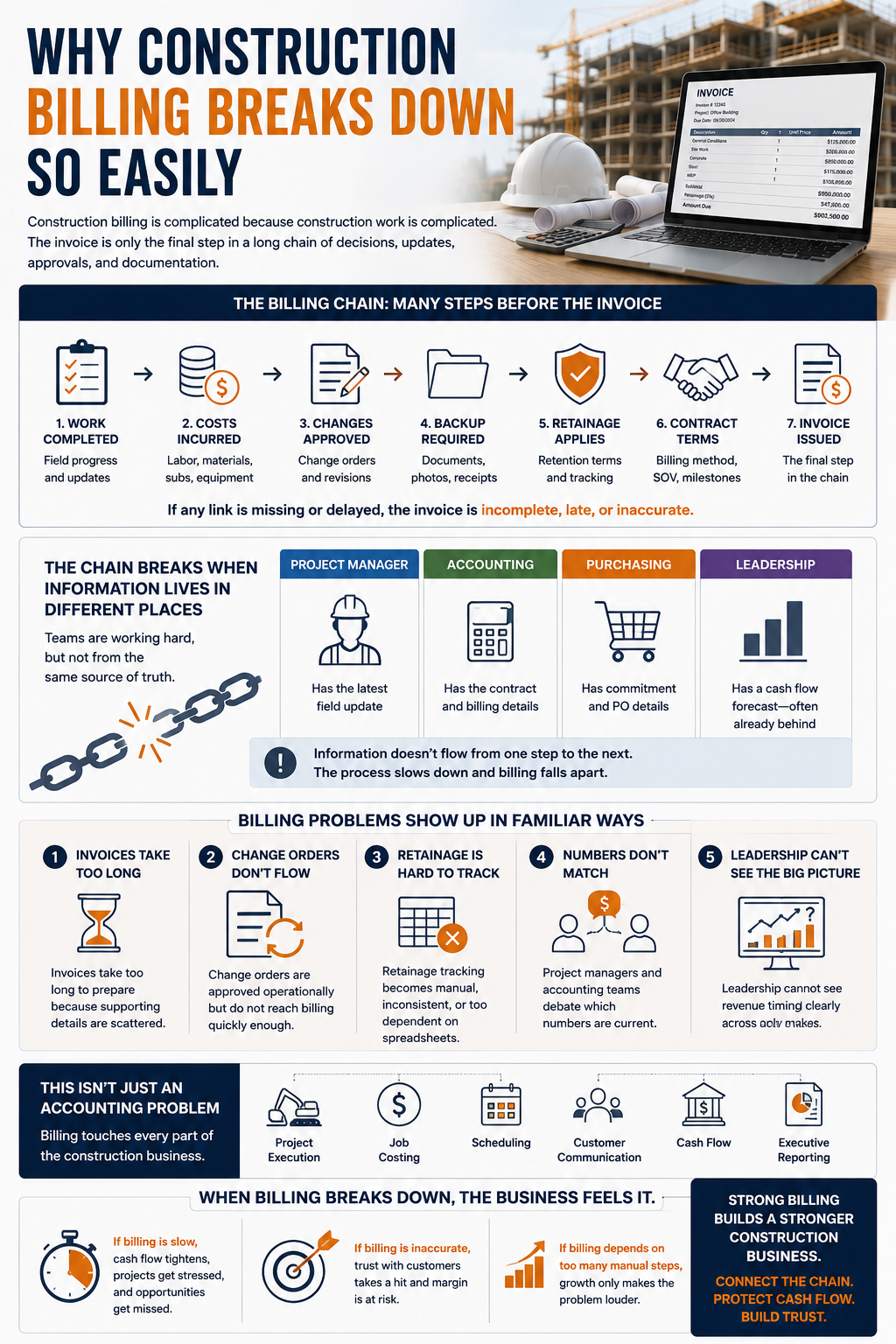
Construction billing and estimating is complicated because construction work is complicated. The invoice is only the final step in a long chain of decisions, updates, approvals, and documentation. Before a billing cycle can close cleanly, the team has to know what work was completed, what costs were incurred, what changes were approved, what backup is required, what retainage applies, and what contract terms control the invoice.
That chain breaks when information lives in different places. A project manager may have the latest field update, accounting may have the contract, purchasing may have the commitment details, and leadership may be looking at a cash flow forecast that is already behind. Everyone may be working hard, but the process still feels slow because the system is not carrying the information from one step to the next.
Billing problems often show up in familiar ways:
- Invoices take too long to prepare because supporting details are scattered.
- Change orders are approved operationally but do not reach billing quickly enough.
- Retainage tracking becomes manual, inconsistent, or too dependent on spreadsheets.
- Project managers and accounting teams debate which numbers are current.
- Leadership cannot see revenue timing clearly across active jobs.
This is not just an accounting problem. Billing touches project execution, job costing, scheduling, customer communication, cash flow, and executive reporting. If billing is slow, the business feels it. If billing is inaccurate, trust takes a hit. If billing depends on too many manual steps, growth only makes the problem louder.
A Strong Billing Workflow Starts Before The Invoice
Contractors often think about billing at the end of the month, but strong billing starts much earlier. It starts when the project is set up, the contract is entered, the schedule of values is structured, the cost codes are assigned, and the approval path is defined. If those early details are messy, the invoice will be messy too.
A cleaner billing workflow should begin with clear project setup. That means contract terms, billing method, retainage rules, milestones, budget structure, and customer requirements need to be captured in a way the team can actually use. A project should not require a separate spreadsheet just to explain how it is supposed to bill. The system should carry that logic throughout the job.
This also means billing needs to stay connected to project activity. If progress is tied to field updates, change order approvals, completed milestones, or cost movements, those details should flow to accounting without a pile of manual follow-up. A system that treats billing as an isolated accounting task overlooks how contractors actually earn revenue.
Billing is not a separate administrative event. It is part of the full project lifecycle, and it works better when the job setup, field progress, approvals, cost tracking, and financial reporting all stay connected.
Change Orders Can Make Or Break Billing Accuracy
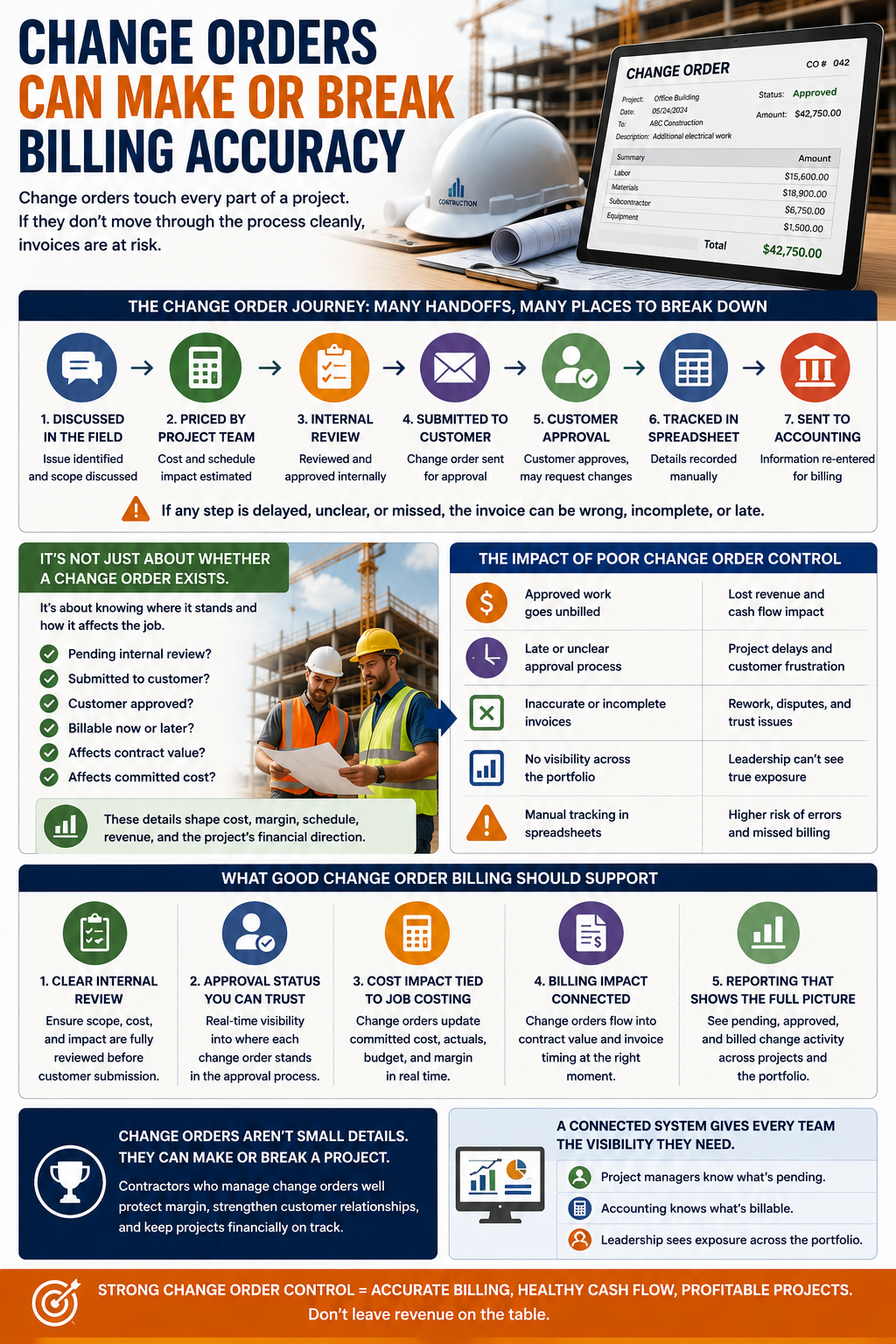
Few things create billing friction faster than change orders. A change may be discussed in the field, priced by the project team, approved by the customer, tracked in a spreadsheet, and eventually sent to accounting. If any part of that path is delayed or unclear, the invoice can be wrong, incomplete, or late. That creates tension with customers and pressure inside the business.
The issue is not only whether a change order exists. The team needs to know where it stands. Is it pending internal review? Has it been submitted? Has the customer approved it? Is it billable now or later? Does it affect the contract value? Does it affect committed cost, margin, schedule, or forecasted revenue? Those details shape the job's financial direction.
A connected system helps contractors manage change order status with more discipline. Project managers can see what is pending. Accounting can see what is billable. Leadership can see exposure across the portfolio. That visibility reduces the risk of leaving approved revenue unbilled or billing work before the right backup is in place.
Change order billing should support:
- Clear internal review before customer submission.
- Approval status that accounting can trust.
- Cost impact tied back to job costing.
- Billing impact connected to contract value and invoice timing.
- Reporting that shows pending, approved, and billed change activity.
Contractors cannot afford to treat change orders like side notes. On complex jobs, they can be the difference between a profitable project and a painful one. The billing workflow needs to account for them as part of the job’s financial structure, not as an afterthought.
Job Costing And Billing Need To Work From The Same Numbers
Billing and job costing are often discussed separately, but they are closely tied. A contractor may bill based on progress, milestones, time and materials, cost plus, or a schedule of values. No matter the billing method, the company needs a clear view of cost, earned revenue, billed revenue, and margin. If job costing and billing are not connected, the team ends up comparing numbers that were never built on the same foundation.
That creates real risk. A project can look fine from a billing standpoint while margin is slipping behind the scenes. Alternatively, a job can carry strong cost performance while invoicing lags, creating cash pressure that leadership does not catch early enough. Contractors need both sides of the picture. They need to know what has been spent, what has been earned, what has been billed, and what remains exposed.
Cost tracking should not sit in a silo away from billing. Labor, materials, subcontractors, equipment, committed costs, actuals, forecasts, and approved changes all shape the financial story of the job. Billing should pull from that same story.
When the two sides are connected, project managers can act sooner. Accounting can prepare invoices with more confidence. Leadership can review revenue timing with a better sense of project health. The company moves away from the old rhythm of waiting, reconciling, correcting, and explaining. Instead, the system gives teams a clearer view of their work before problems become harder to fix.
Field Updates Should Feed The Billing Process
The field often knows the truth first. Crews know what was completed, what got delayed, what changed, what materials arrived, and what work is ready for review. If that information does not reach the office efficiently, billing slows down. Accounting cannot invoice what it cannot verify, and project managers should not have to rebuild every update manually at the end of the month.
A connected workflow helps field updates move into the financial process faster. That does not mean every field note becomes an invoice line. It means progress, status, completed work, documentation, and issue tracking should be visible to the people who need that information. The office should not have to chase three people just to confirm whether a billing milestone was reached.
This is especially important for contractors handling multiple active jobs. A single delay may be manageable. Ten delays across ten jobs can create a serious revenue timing issue. If leadership cannot see those delays early, cash flow forecasting becomes reactive. The same applies to work completed ahead of schedule. If the system does not surface progress, the company may wait too long to bill work it has already earned.
When using NetSuite for construction practical workflows businesses need a more connected way of running daily operations. Field activity, project management, accounting, and leadership reporting should not be forced into separate lanes. The cleaner the handoff from field to office, the cleaner the billing process becomes.
Retainage, WIP, And Progress Billing Need Better Control
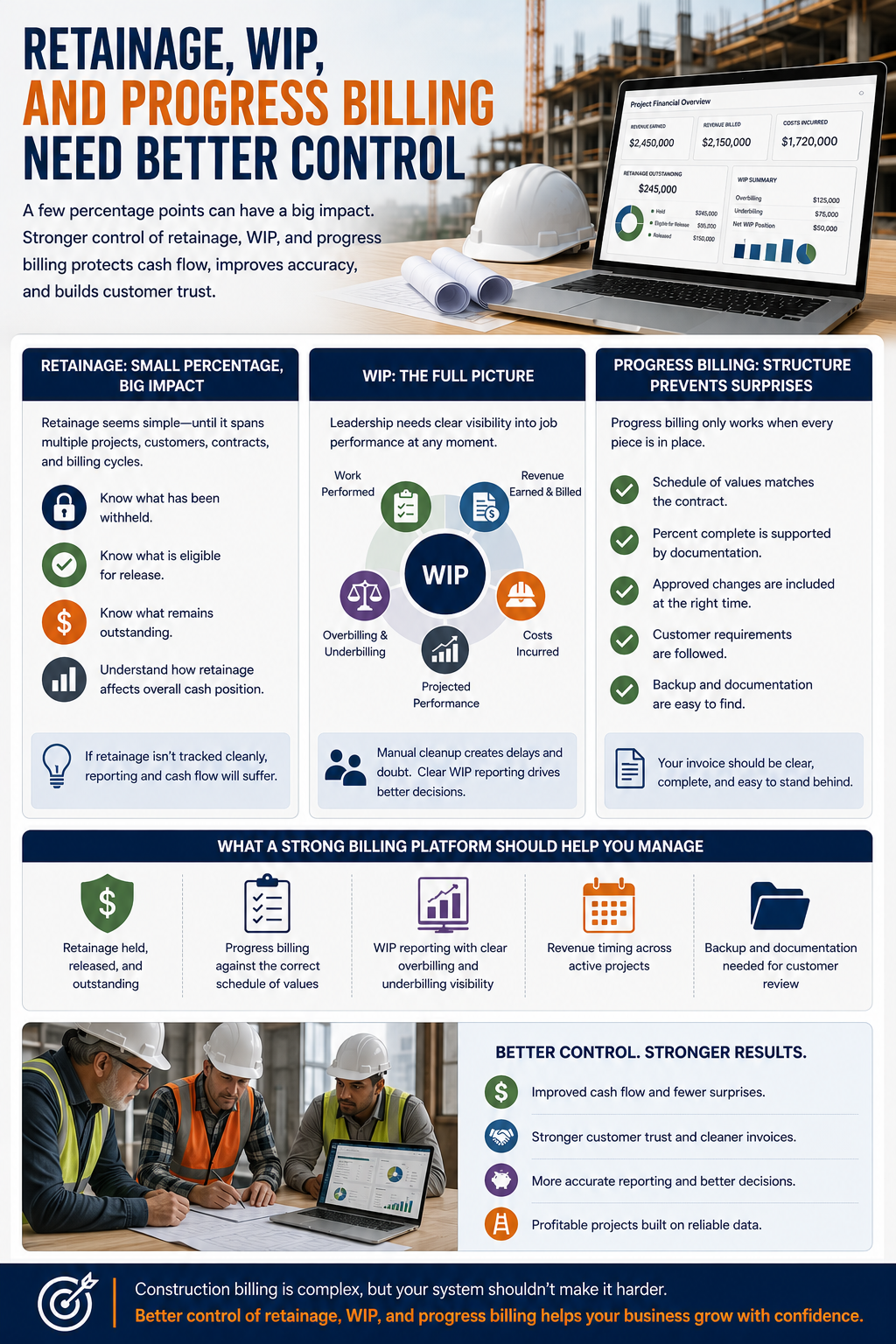
Retainage is one of those construction details that looks simple until it is spread across many projects, customers, contracts, and billing cycles. A few percentage points held back can create major reporting and cash-flow questions if the system does not track them cleanly. Contractors need to know what has been withheld, what is eligible for release, what remains outstanding, and how retainage affects the overall cash position.
WIP creates another layer. Leadership needs to understand the work performed, revenue earned and billed, costs incurred, overbilling and underbilling, and projected performance. If WIP reporting depends on manual cleanup each month, the team spends too much time assembling the numbers and not enough time acting on them. The process may produce a report, but that does not mean the report was easy to trust.
Progress billing also requires structure. The schedule of values needs to match the contract. Percent complete must be supported. Approved changes need to be included at the right time. Customer requirements need to be followed. Backup needs to be available. The invoice should not become a detective story every month.
A stronger billing platform should help manage:
- Retainage held, released, and outstanding.
- Progress billing against the correct schedule of values.
- WIP reporting with clear overbilling and underbilling visibility.
- Revenue timing across active projects.
- Backup and documentation needed for customer review.
These details affect cash flow, customer trust, and leadership visibility. Better control does not mean more complexity for the team. It means the system is built to handle the complexity inherent in construction billing.
The Right System Makes Cash Flow Easier To Forecast
Cash flow is one of the biggest reasons billing needs stronger systems. Contractors carry labor, materials, equipment, subcontractor costs, insurance, overhead, and vendor obligations before every customer pays. If billing slips, the company feels it quickly. If collections lag, the pressure gets even tighter. Good billing workflows help leadership see what is coming, what is delayed, and what needs attention.
The goal is not just to send invoices faster. The goal is to understand revenue movement across the business. Which invoices are ready? Which ones are waiting on approval? Which projects are underbilled? Which customers have retainage outstanding? Which change orders could affect the next billing cycle? Which jobs are creating cash pressure because cost is moving faster than revenue?
A connected ERP environment gives leadership a better way to answer those questions. Instead of reviewing cash flow from static spreadsheets, leaders can view billing status, job progress, cost exposure, and collections in a more connected way. That helps the company plan with more confidence.
Cash flow forecasting improves when teams can see:
- What has been earned but not yet billed.
- What has been billed but not yet collected.
- What retainage is still outstanding.
- What change orders could affect upcoming revenue.
- What job costs are moving ahead of billing.
- What project delays may push revenue into a later period.
Contractors do not need more vague reporting. They need billing data that helps them act. A clearer cash flow picture helps leadership manage timing, staffing, purchasing, and growth with fewer surprises.
Implementation Design Decides Whether The System Works
A billing platform can look strong in a demo and still fail in daily use. The difference often comes down to implementation design. Construction billing has too many company-specific details to rely on generic setup. Contract types, cost codes, approval paths, reporting definitions, permissions, customer requirements, retainage rules, and billing formats all need careful attention.
If implementation is rushed, the team may recreate old problems inside a new system. Spreadsheets stay in place. Accounting still asks for manual backup. Project managers still track changes outside the platform. Leadership still questions the reports. At that point, the company has not solved the billing issue. It has only moved the frustration into a more expensive environment.
A better implementation starts with workflow clarity. How does a job move from setup to closeout? Who approves changes? What information does accounting need before billing? How are field updates captured? What reports does leadership need each week or month? Which processes should be standardized, and which ones need flexibility? These answers should shape the system before the team is expected to use it.
Where BlueCollar Fits For Contractors That Need Better Billing
BlueCollar helps construction companies bring accounting, project management, billing, job costing, and reporting closer together inside NetSuite. The focus is not only on creating a cleaner invoice process. It is on helping contractors build a connected operating environment where billing reflects real project activity and leadership can see the financial picture with more confidence.
That is important because billing rarely fails in isolation. It fails because project setup is unclear, change orders are slow, field updates are disconnected, job costs are incomplete, retainage is tracked manually, or reporting definitions are inconsistent. BlueCollar helps address those connection points so the business can operate with less rework and stronger visibility.
For contractors already evaluating NetSuite for construction, billing should be part of the larger ERP conversation. The system should support how work is won, planned, executed, billed, collected, and reviewed. Stronger billing is not just about accounting efficiency. It is about giving the entire company a cleaner view of job performance and revenue movement.
Build A Cleaner Billing Workflow With BlueCollar
If billing still depends on spreadsheets, late updates, disconnected approvals, and month-end chasing, it may be time to rethink the workflow. BlueCollar helps construction teams connect the pieces that shape billing accuracy, cash flow, job costing, and project visibility inside NetSuite. The result is a stronger operating foundation for contractors that need cleaner processes and better control.
Talk with BlueCollar about how your current billing process works, where it slows down, and what your team needs to see sooner. A better billing workflow should help accounting move faster, help project managers stay aligned, and help leadership make decisions from numbers they can trust.
Frequently Asked Questions About Construction Billing Software
What Is Construction Billing Software?
Construction billing software helps contractors manage invoices, progress billing, retainage, change orders, customer requirements, and revenue tracking in a more organized system. It is designed to support the billing complexity of construction projects, where work may be billed by milestone, percentage complete, time and materials, cost-plus, or schedule of values. The strongest systems connect billing with job costing, project activity, accounting, and reporting. That connection helps contractors reduce manual work and improve billing accuracy.
How Does Construction Billing Software Help Contractors?
It helps contractors prepare invoices faster, track retainage more clearly, connect approved changes to billing, and improve visibility into earned and billed revenue. It also reduces the amount of manual follow-up between project managers and accounting teams. Instead of chasing updates across emails, spreadsheets, and separate tools, the team can work from a more connected process. That helps protect cash flow and reduces the risk of missed or delayed billing.
What Features Should Contractors Look For In A Billing Platform?
Contractors should look for progress billing, schedule-of-values support, retainage tracking, change-order billing, job-cost integration, approval workflows, documentation management, and reporting. The system should also support the company’s contract types and customer billing requirements. A strong platform should help accounting and project teams work from the same information. If the tool only creates invoices but does not connect to project activity, it may not solve the bigger billing problem.
How Does Billing Software Improve Cash Flow?
Billing software improves cash flow by helping contractors invoice more accurately and with fewer delays. It gives teams better visibility into what has been earned, what is ready to bill, what is awaiting approval, and what has not yet been collected. That clarity helps leadership forecast revenue timing and spot billing bottlenecks earlier. Cleaner billing does not remove every cash flow challenge, but it gives the company better control over the process.
Does Construction Billing Software Help With Retainage?
Yes, the right system can help contractors track retainage held, retainage released, and retainage still outstanding across projects. This is important because retainage can affect cash flow, reporting, and project closeout. Manual retainage tracking can become messy as project volume grows. A connected billing workflow helps teams manage retainage more consistently and with fewer spreadsheet dependencies.
Can Billing Software Connect To Job Costing?
Yes, and that connection is one of the most important parts of a strong construction billing workflow. Job costing shows how the project is performing financially, while billing shows how revenue is being captured and collected. If those two views are disconnected, the company may miss margin pressure, underbilling, overbilling, or delayed revenue. A connected system helps project managers, accounting, and leadership work from a clearer financial picture.
When Should A Contractor Replace Manual Billing Processes?
A contractor should consider replacing manual billing processes when invoices take too long to prepare, project managers and accounting teams rely on different numbers, retainage tracking becomes inconsistent, and change orders regularly delay billing. Another clear sign is when leadership cannot see earned revenue, billed revenue, and cash flow exposure without a manual report. Manual processes often feel manageable until the company grows. At that point, the time spent fixing billing problems starts costing more than the old process is worth.
Is NetSuite A Good Option For Construction Billing?
NetSuite can be a strong option for construction billing when it is configured around contractor workflows. It can support financial management, project visibility, reporting, billing processes, and operational scale, but the setup has to reflect how the company actually manages jobs. Construction billing involves details that generic configurations may miss. BlueCollar helps construction companies shape NetSuite to reflect those realities so that billing, job costing, accounting, and project management work together more cleanly.