Construction With NetSuite: How Contractors Connect The Dots on Projects, Costs, Billing, And Growth

Construction companies are not short on effort. They are usually short on connected systems. Project managers track work in one place, accounting works from another, schedules move in a separate tool, and leadership waits too long for a reliable view of job health.
That is why more contractors are running construction operations with NetSuite as a connected operating foundation rather than a patchwork of accounting software, spreadsheets, and project apps. NetSuite can bring operations, accounting, project management, job costing, scheduling, and reporting into a single centralized system for contractors who need tighter control across the business.
The goal is not just better software. The goal is a better way to run construction work while projects are still moving, costs are still changing, and decisions still have time to protect margin. Contractors need job data, financial data, field updates, billing details, and leadership reporting to support one another rather than compete for attention.
Why Contractors Start Looking At NetSuite
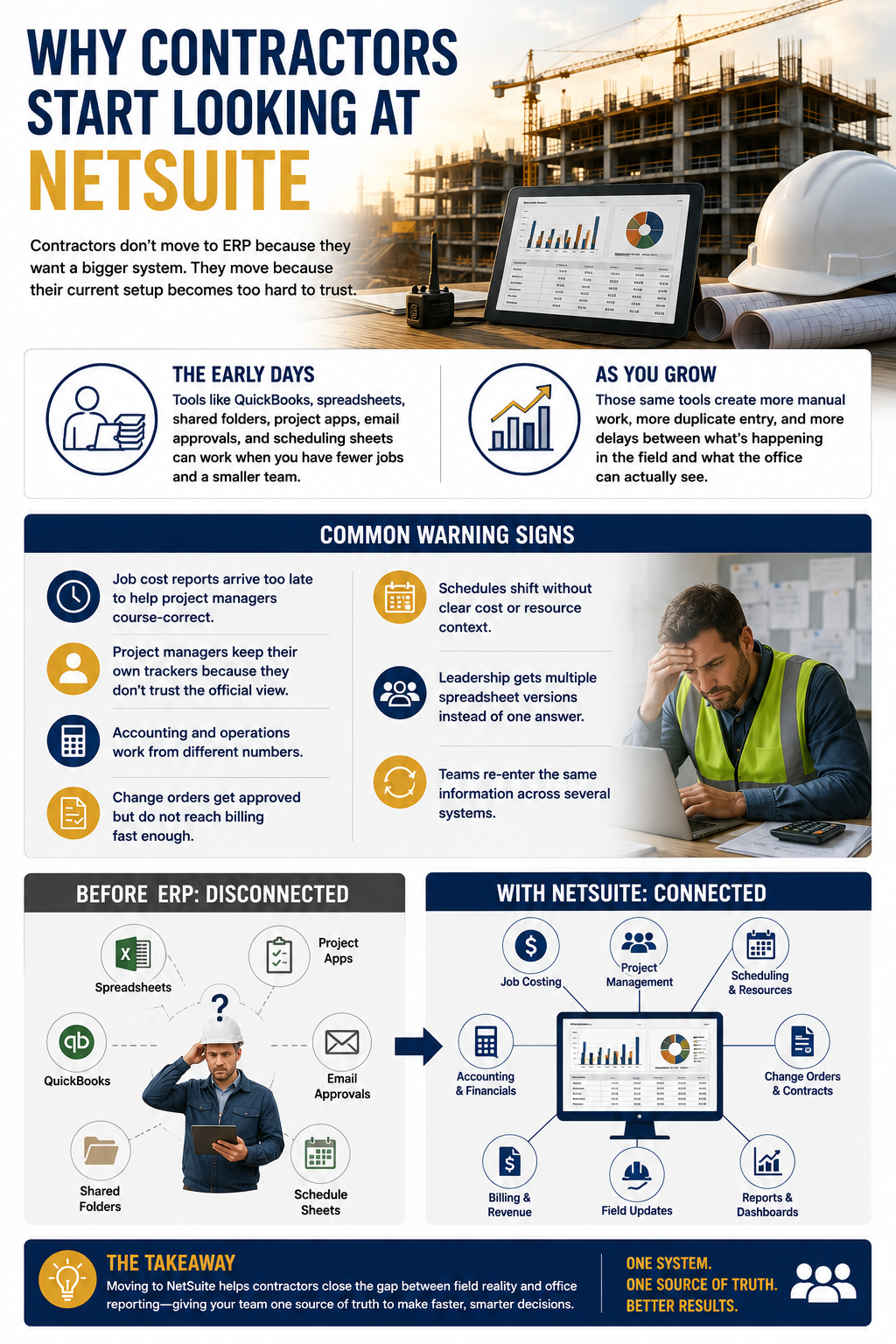
Most contractors do not move toward ERP because they want a bigger system. They start looking because the current setup becomes too hard to trust. A spreadsheet is added to cover a reporting gap, a project manager keeps a personal tracker, and accounting spends more time chasing down backups than helping the business act sooner.
Disconnected tools can work for a while. QuickBooks, shared folders, standalone project apps, email approvals, and scheduling spreadsheets may feel manageable when project volume is lower. As the company grows, those same tools create more manual work, more duplicate entry, and more delays between what is happening in the field and what the office can see.
Common warning signs include:
- Job cost reports arrive too late to help project managers course-correct.
- Project managers keep their own trackers because they do not trust the official view.
- Accounting and operations work from different numbers.
- Change orders get approved but do not reach billing fast enough.
- Schedules shift without clear cost or resource context.
- Leadership gets multiple spreadsheet versions instead of one answer.
- Teams re-enter the same information across several systems.
Contractors often reach this point after they have outgrown disconnected construction tools. A connected ERP system can reduce the gap between field reality and office reporting, giving teams access to a single source of truth while work is still in progress.
What NetSuite Can Bring Together For Construction Companies
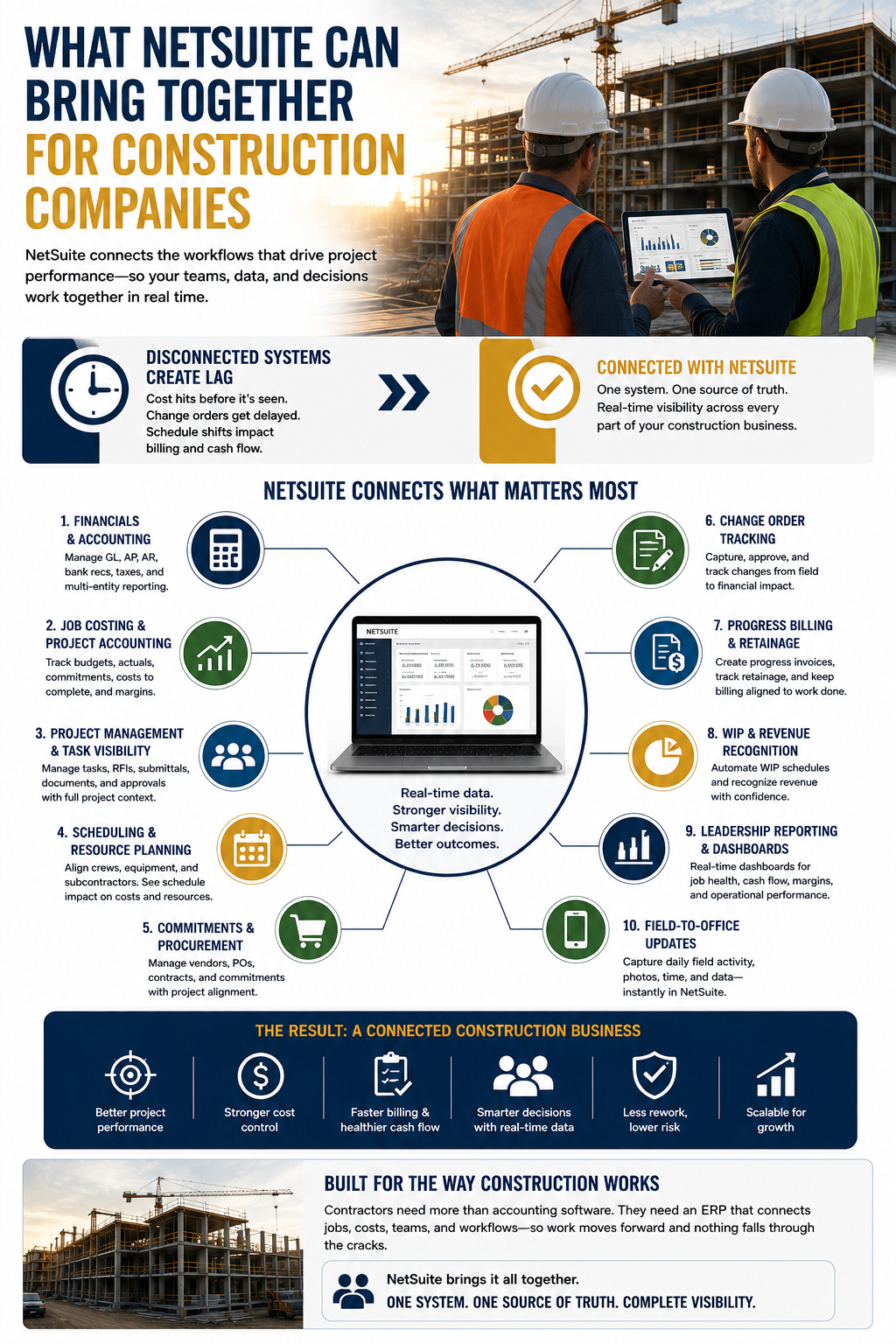
NetSuite is most useful for contractors when it connects the workflows that affect project performance. That means more than replacing accounting software. Construction companies need accounting, job costing, project management, scheduling visibility, procurement, change orders, billing, retainage, WIP, reporting, and field-to-office updates to work together.
A contractor may have each of those areas covered in separate tools, but separation creates lag. Costs may hit the job before project teams see the trend. Change orders may move through field approval before billing has what it needs. A schedule delay may affect labor, materials, billing, and cash flow before leadership sees the risk.
A practical NetSuite construction setup can connect:
- Financials and accounting.
- Job costing and project accounting.
- Project management and task visibility.
- Scheduling and resource planning.
- Commitments and procurement.
- Change order tracking.
- Progress billing and retainage.
- WIP and revenue recognition.
- Leadership reporting and dashboards.
- Field-to-office updates.
Contractors comparing NetSuite for construction companies should focus on how the system supports the way work actually moves. A general ERP setup may help finance, but construction teams need workflows shaped around jobs, cost codes, commitments, project status, billing, and field activity.
Job Costing Becomes More Useful When It Is Connected
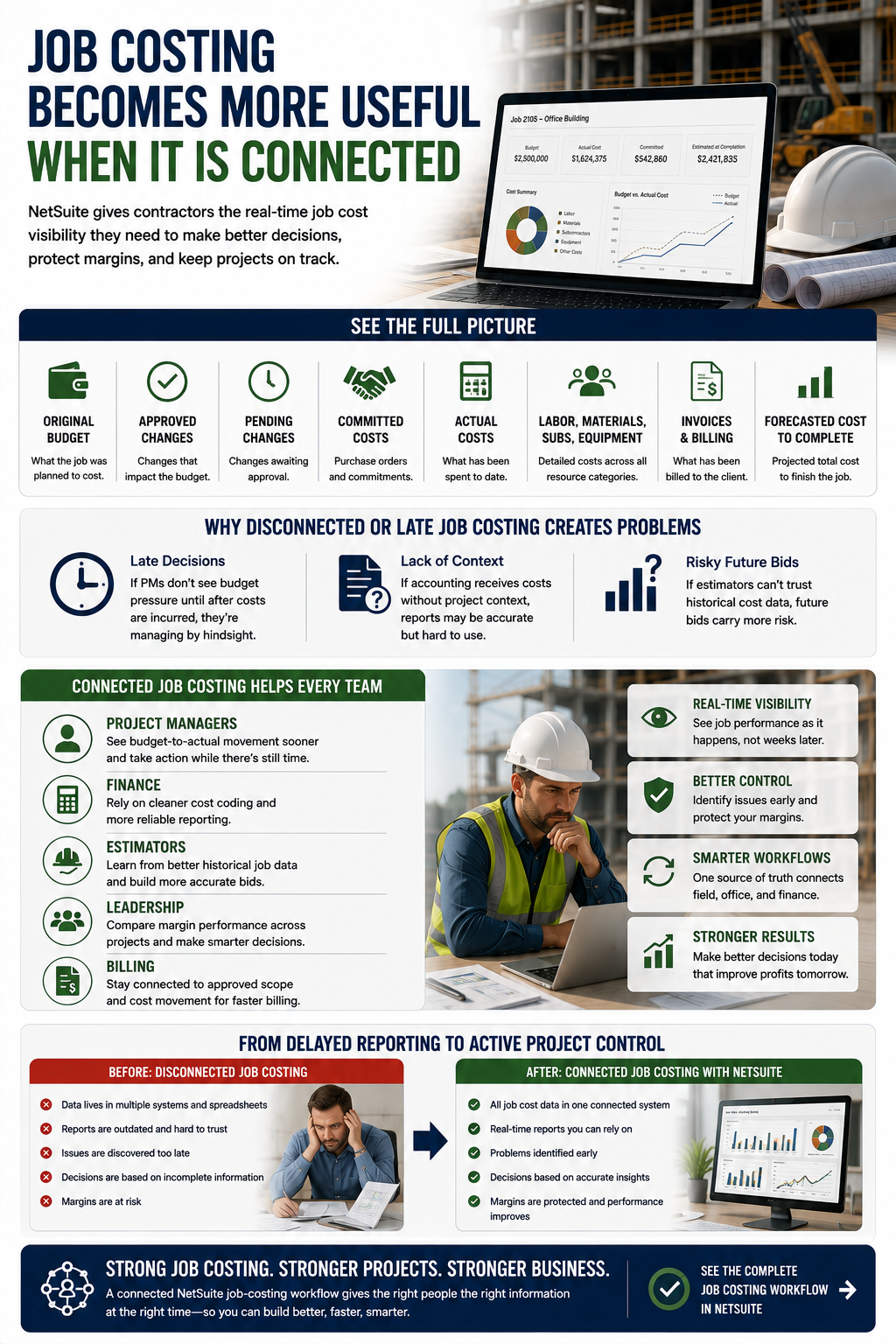
Job costing is one of the biggest reasons contractors consider NetSuite. A contractor needs to know not only what has already been spent. The team needs to see the original budget, approved changes, pending changes, committed costs, actual costs, labor, materials, subcontractors, equipment, invoices, and forecasted cost to complete.
Late job costing creates late decisions. If project managers do not see budget pressure until after cost has already been incurred, they are managing by hindsight. If accounting receives costs without project context, reports may be technically accurate but still hard to use. If estimators cannot trust historical cost data, future bids carry more risk.
Connected job costing helps each group work better:
- Project managers can see budget-to-actual movement sooner.
- Finance can rely on cleaner cost coding and reporting.
- Estimators can learn from better historical job data.
- Leadership can compare margin performance across active work.
- Billing can stay connected to approved scope and cost movement.
A strong NetSuite construction job-costing workflow helps contractors move from delayed reporting to active project control. The sooner the right people can see cost movement, the sooner they can decide what to adjust, what to escalate, and what needs a closer look.
Accounting And Operations Need To Work From The Same Truth
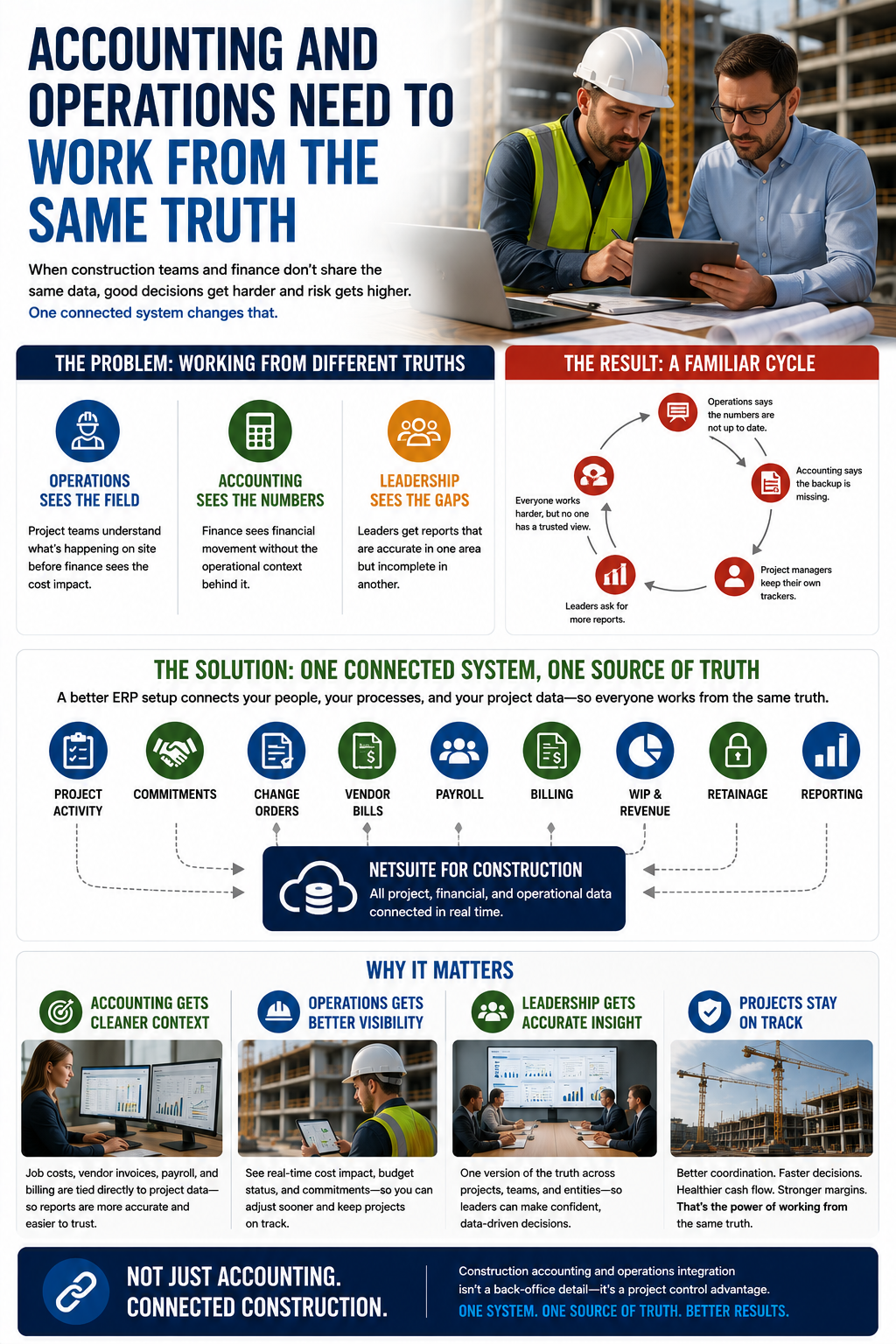
Construction companies run into trouble when accounting and operations are treated as separate businesses. Project teams may understand field reality before finance sees the cost impact. Accounting may see financial movement without the operational context behind it. Leadership may receive reports that are accurate in one area but incomplete in another.
The result is a familiar cycle. Operations says the numbers are not up to date. Accounting says the backup is missing. Project managers keep their own trackers. Leaders ask for more reports, and everyone works harder without gaining one trusted view.
A better ERP setup should connect project activity, commitments, change orders, vendor bills, payroll, billing, WIP, retainage, and reporting. NetSuite construction accounting can tie job costs, vendor invoices, payroll, and billing directly to project data when the system is configured around the contractor’s workflows.
That is why construction accounting and operations integration is not a back-office detail. It is a project control issue. Accounting gets cleaner context, operations gets better financial visibility, and leadership gets a more accurate view of performance.
Project Management Has To Fit How Contractors Actually Work
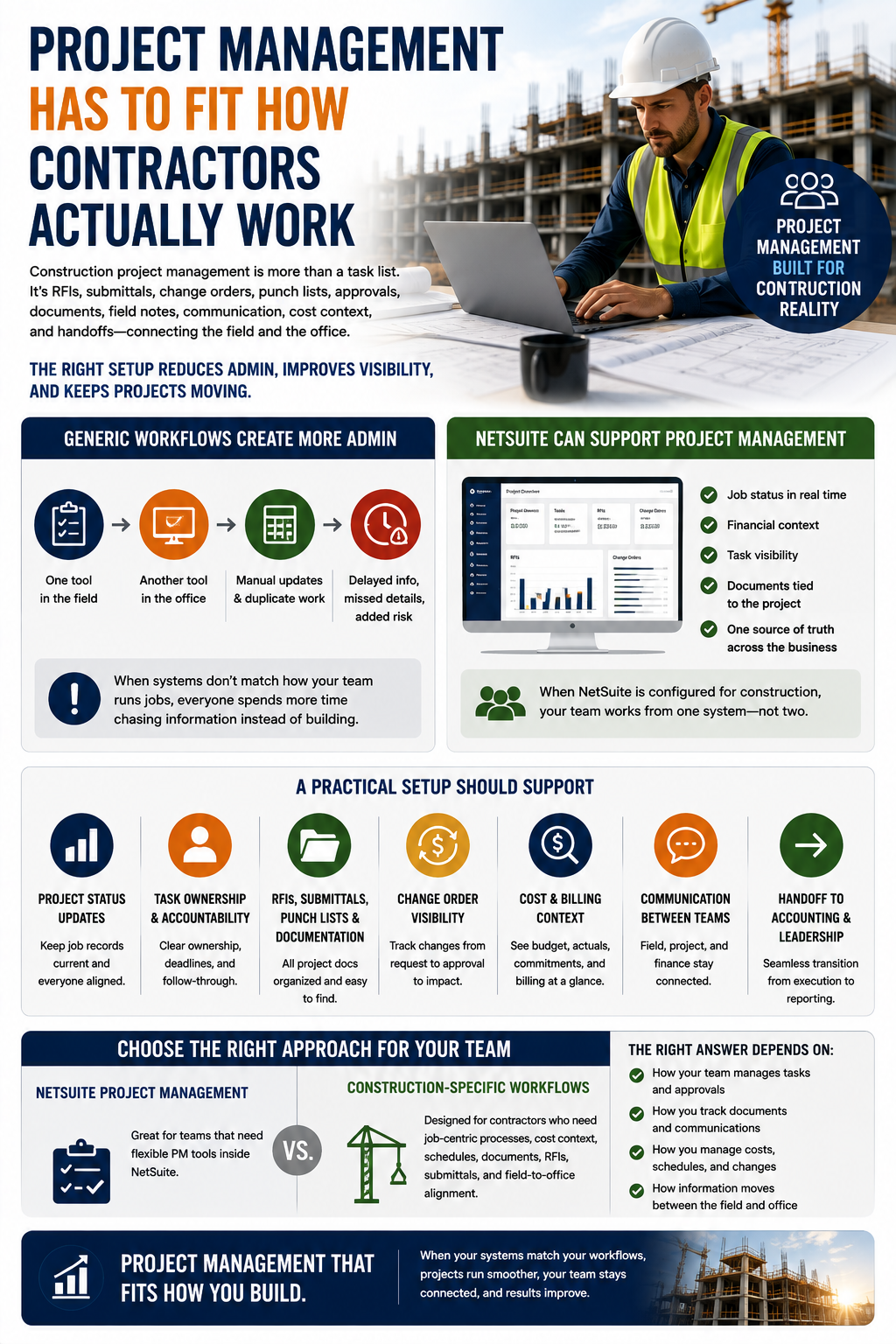
Construction project management is not just a task list. It involves RFIs, submittals, change orders, punch lists, approvals, documents, field notes, project communication, cost context, and handoffs between the field and the office. A generic workflow can create more admin work if it does not align with how project managers actually run jobs.
NetSuite can support project management, but contractors need the setup to reflect real construction work. Project managers need current job status, financial context, task visibility, and documentation tied to the project record. They also need the system to reduce duplicate work, rather than forcing them to update one tool for the office and another for themselves.
A practical setup should support:
- Project status updates tied to the job record.
- Task ownership and accountability.
- RFIs, submittals, punch lists, and documentation.
- Change order visibility.
- Cost and billing context.
- Communication between field, project, and finance teams.
- Handoff from project execution to accounting and leadership reporting.
Contractors considering NetSuite project management for growing teams should also understand how managing projects in NetSuite differs from construction-specific project workflows. The right answer depends on how the company manages tasks, documents, costs, schedules, and field-to-office movement.
Scheduling Visibility Should Connect To The Rest Of The Business
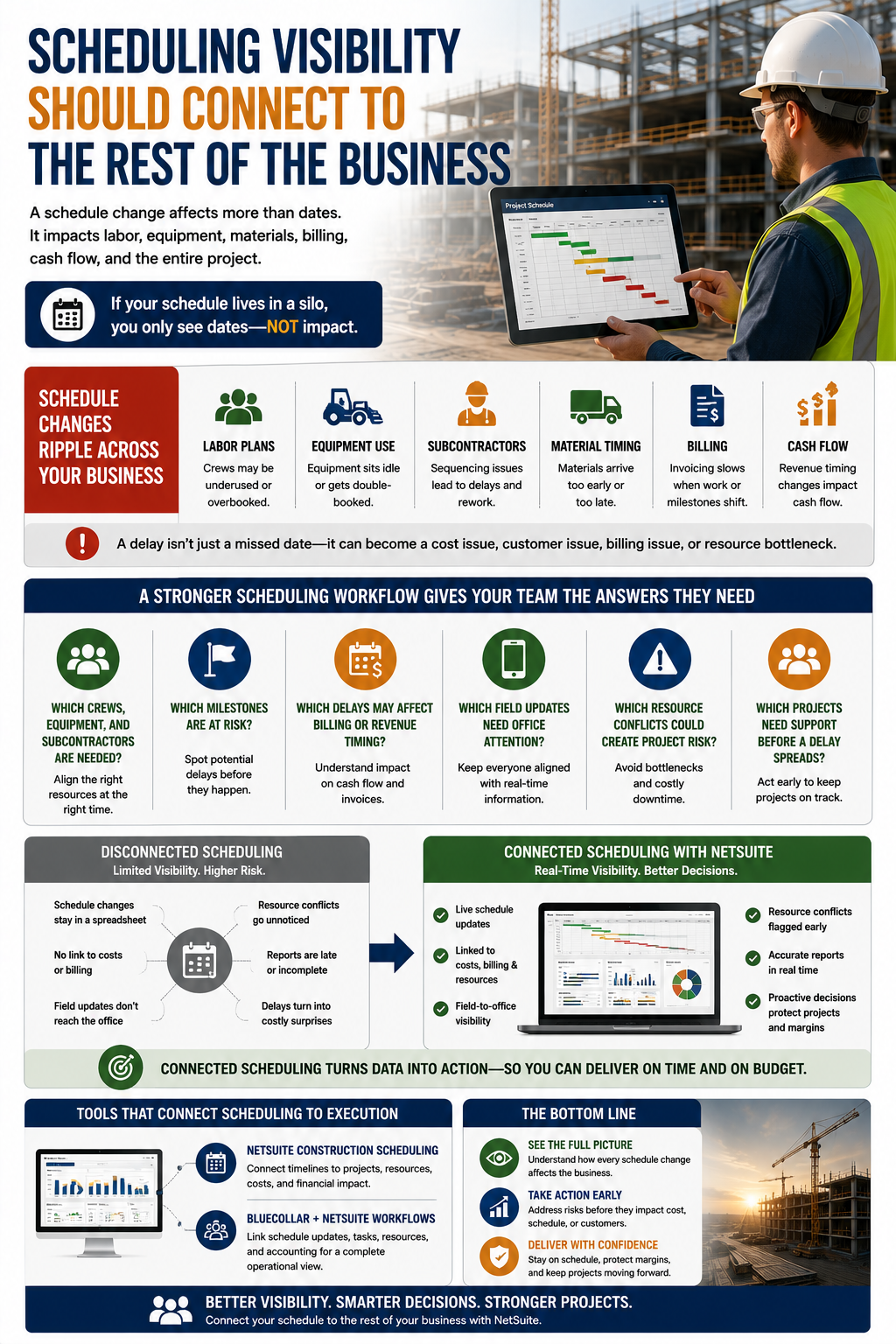
Scheduling is often treated like a project management problem, but schedule changes affect the whole business. A delay can shift labor plans, impact equipment usage, affect subcontractor sequencing, create material timing issues, slow billing, and change cash flow expectations. If the schedule falls outside the ERP conversation, the company may see dates without understanding the business impact.
Construction teams need scheduling visibility that connects with project status, resource planning, costs, billing, and leadership reporting. A schedule delay is not only a missed date. It can become a cost issue, a customer issue, a billing issue, or a resource bottleneck.
A stronger scheduling workflow should help teams understand:
- Which crews, equipment, and subcontractors are needed.
- Which milestones are at risk.
- Which delays may affect billing or revenue timing.
- Which field updates need office attention.
- Which resource conflicts could create project risk.
- Which projects need support before a delay spreads.
Tools for NetSuite construction scheduling can help contractors connect timeline visibility to project execution. Workflows built around managing project schedules in BlueCollar and NetSuite go further by tying schedule updates, task tracking, resource planning, and accounting context into a cleaner operating view.
Billing, Cash Flow, And Revenue Need Cleaner Construction Workflows
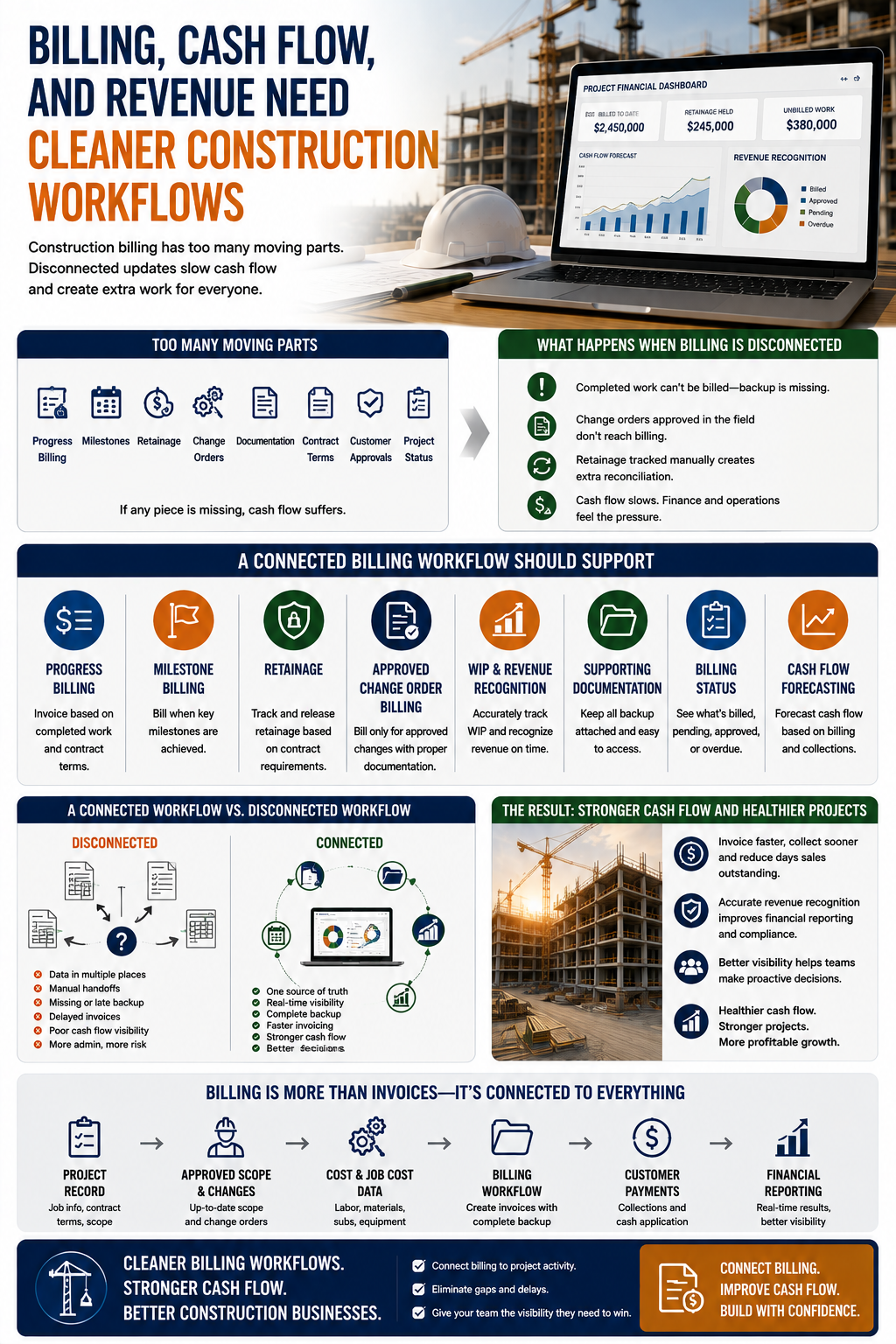
Construction billing has too many moving parts to depend on disconnected updates. Progress billing, milestones, retainage, approved change orders, supporting documentation, contract terms, customer approvals, and project status all affect how cash moves through the business. If billing is disconnected from project activity and job cost data, cash flow slows down.
A project may have completed billable work, but billing cannot proceed because the backup is missing. A change order may be approved in the field, but not reflected in the billing workflow. Retainage may be tracked manually, which creates extra reconciliation later. These gaps create real pressure for finance and operations.
A connected workflow should support:
- Progress billing.
- Milestone billing.
- Retainage.
- Approved change order billing.
- WIP and revenue recognition.
- Supporting documentation.
- Billing status.
- Cash flow forecasting.
This is where construction billing software and ERP workflows overlap. Contractors need more than invoice creation. They need billing connected to the project record, contract terms, approved scope, cost movement, and financial reporting.
Leadership Reporting Should Make The Business Easier To Steer
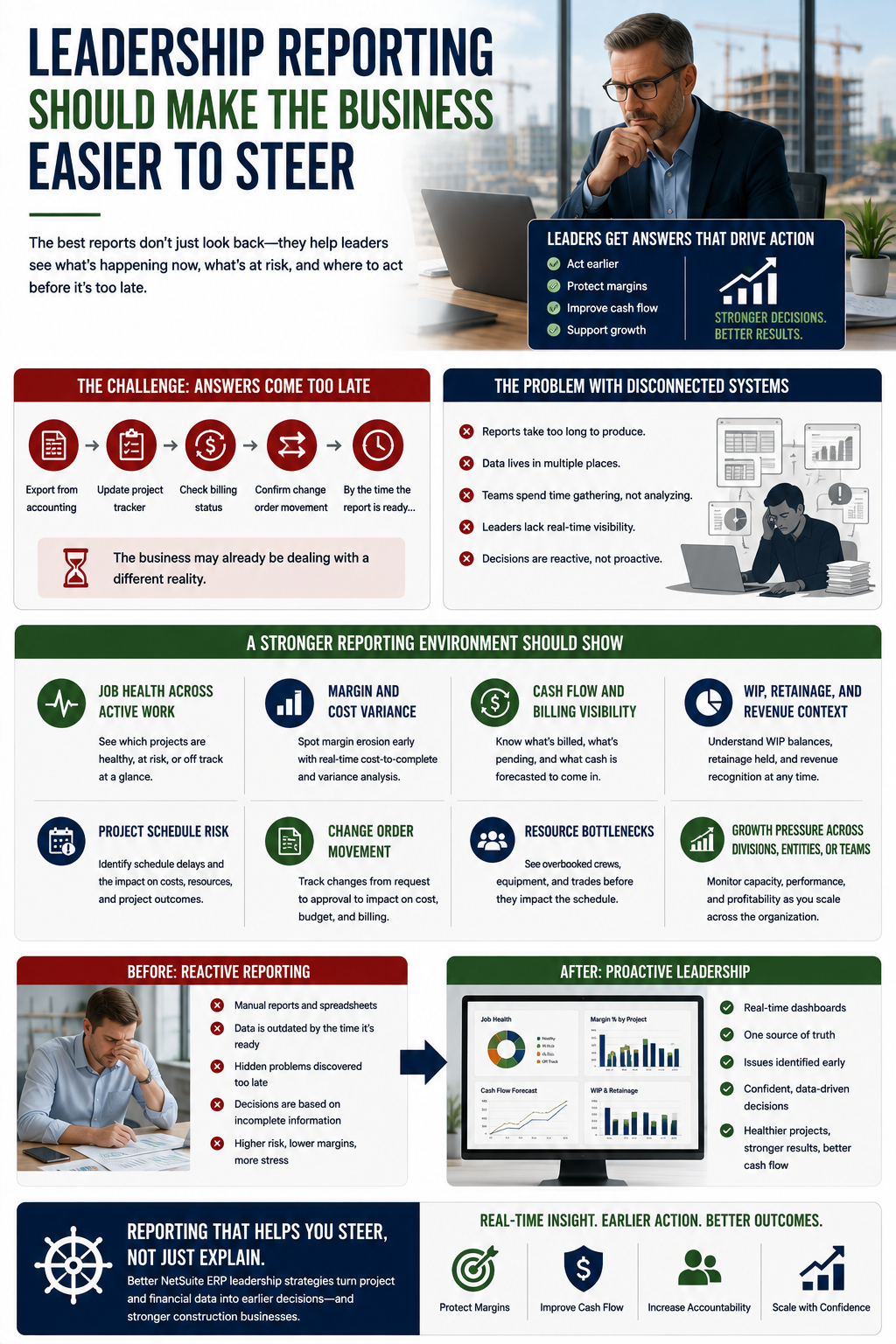
Leadership reporting should help executives act before it is too late to make a difference. Contractors need to know which jobs are healthy, which jobs are slipping, where margin is at risk, where billing is delayed, where cash flow may tighten, and where growth is creating operational strain. They should not need a week of spreadsheet cleanup to answer basic business questions.
Disconnected systems create reporting delays because every answer has to be assembled manually. Someone exports from accounting. Someone updates the project tracker. Someone checks billing status. Someone confirms the change order movement. By the time the report is ready, the business may already be dealing with a different reality.
A stronger reporting environment should show:
- Job health across active work.
- Margin and cost variance.
- Cash flow and billing visibility.
- WIP, retainage, and revenue context.
- Project schedule risk.
- Change order movement.
- Resource bottlenecks.
- Growth pressure across divisions, entities, or teams.
Better NetSuite ERP leadership strategies for construction turn project and financial data into earlier decisions. Leaders need reporting that helps them steer the business, not reporting that only explains what already happened.
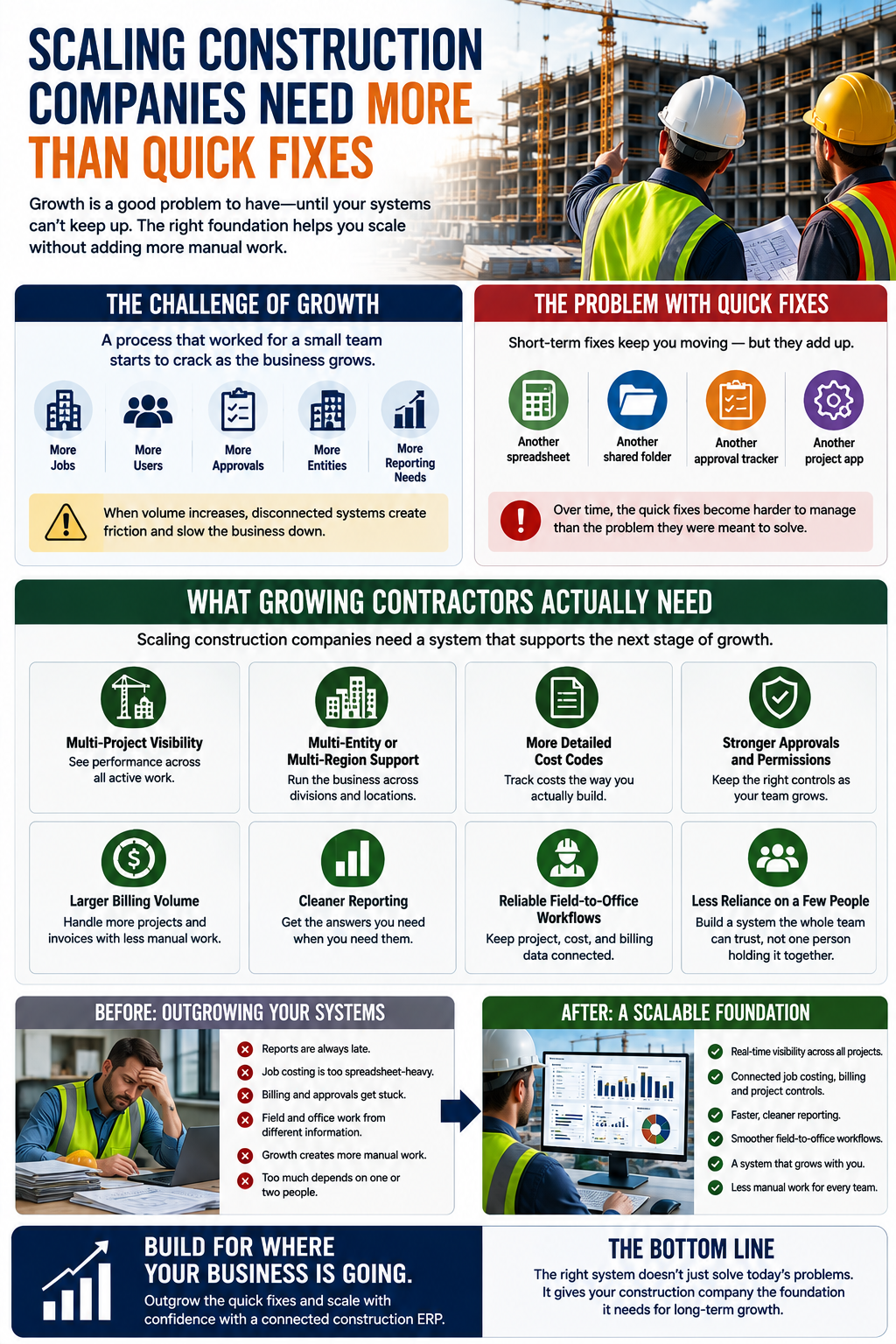
Scaling Construction Companies Need More Than Quick Fixes
Growing contractors eventually need systems that can support more jobs, users, approvals, entities, reporting needs, and field-to-office coordination. A process that worked for a smaller team can begin to crack when volume increases. The business may still be growing, but the systems behind it may be creating friction.
Quick fixes can keep the company moving for a while. Another spreadsheet, another approval tracker, another shared folder, or another project app can cover the next problem. Over time, those fixes become harder to manage than the problem they were meant to solve.
Scaling contractors often need:
- Multi-project visibility.
- Multi-entity or multi-region support.
- More detailed cost codes.
- Stronger approvals and permissions.
- Larger billing volume.
- Cleaner reporting.
- More reliable field-to-office workflows.
- Less reliance on one or two people holding the process together.
A contractor evaluating NetSuite construction scaling is usually looking beyond today’s pain. The company needs a foundation that can support the next stage of growth without forcing every department to take on more manual work. For many teams, the QuickBooks breaking point arrives when reporting, job costing, billing, and project controls no longer keep up with the business.
Where BlueCollar Fits In Construction With NetSuite
NetSuite can provide the ERP backbone, but construction companies still need workflows that fit how contractors manage jobs, costs, billing, schedules, change orders, project reporting, and field-to-office updates. A generic setup may not support the level of construction detail the business needs. Contractors need a system designed around how their team actually works.
BlueCollar helps shape NetSuite to better reflect construction realities. That includes job costing, project controls, billing, WIP, retainage, scheduling visibility, project management workflows, and leadership reporting. The goal is to make NetSuite useful for daily construction operations, not just month-end accounting.
BlueCollar can support contractors with:
- NetSuite as the ERP backbone.
- Construction-specific workflow design.
- BlueCollar Projects and extensions.
- Job costing and project controls.
- Billing, WIP, and retainage visibility.
- Project management workflows.
- Scheduling and operational visibility.
- Field-to-finance connection.
- Leadership reporting for construction teams.
Contractors exploring BlueCollar Projects in NetSuite are usually trying to bring accounting and project management closer together. BlueCollar helps bridge that gap with construction-focused workflows that support the planning, tracking, billing, and reporting of jobs.
Questions Contractors Should Ask Before Running Construction With NetSuite
NetSuite works best when the implementation is designed around how the contractor operates. A generic setup will not solve construction-specific workflow problems. Contractors should evaluate the system, configuration, and implementation approach together.
Useful questions include:
- Can job costing track budget, committed cost, actual cost, pending changes, and forecast cost to complete?
- Can project managers and accounting work from the same project data?
- Can change orders connect to budget, billing, and reporting?
- Can scheduling connect to labor, materials, dependencies, and project status?
- Can billing support progress billing, retainage, milestones, and contract changes?
- Can leaders see job health without rebuilding spreadsheets?
- Can field teams update information without creating more office work?
- Can the system support multiple entities, divisions, projects, and users as the company grows?
- Can implementation be shaped around how the team actually works?
Contractors comparing the best ERP software for construction should look beyond feature lists. The better question is whether the system can support the full workflow from project activity to cost control to billing to leadership visibility. That is also why many teams compare the best construction ERP based on workflow fit, not just platform name.
Build A More Connected Construction Business With BlueCollar
If your team is spending too much time reconciling spreadsheets, chasing project updates, or trying to understand which numbers are current, BlueCollar can help. We help contractors turn NetSuite into a construction-ready operating foundation for job costing, billing, project management, scheduling visibility, reporting, and growth.
The right system should give project managers, accounting, field teams, and leadership a clearer way to work from the same information. It should reduce duplicate entry, improve visibility, and help the business make better decisions before problems become expensive.
Book a demo to see how BlueCollar supports construction workflows in NetSuite.
Frequently Asked Questions About Construction With NetSuite
What Does Construction With NetSuite Mean?
Construction with NetSuite means using NetSuite as an ERP foundation for accounting, job costing, project management, billing, reporting, scheduling visibility, and operations. For contractors, the value comes from connecting project activity with financial information so teams are not working from separate systems. It can help accounting, operations, project managers, and leadership work from one trusted source of truth. The setup needs to reflect construction workflows, not just general business accounting.
Is NetSuite Good For Construction Companies?
Yes, NetSuite can be a strong fit for growing construction companies that need better job costing, project accounting, billing, reporting, and operational visibility. It is especially useful when contractors have outgrown spreadsheets, QuickBooks, or disconnected project tools. Construction-specific configuration is important because contractors need support for job cost detail, change orders, WIP, retainage, billing, scheduling visibility, and reporting. NetSuite becomes more valuable when it is shaped around how construction teams actually work.
How Does NetSuite Help With Construction Job Costing?
NetSuite can help with construction job costing by connecting budgets, actual costs, commitments, labor, materials, subcontractors, equipment, change orders, and forecast cost-to-complete. This gives project managers and finance teams a better view of budget-to-actual movement while the job is still active. It also helps leadership compare margin performance across projects. Cleaner job costing gives estimators better historical data for future bids.
Can NetSuite Connect Accounting And Operations?
Yes, NetSuite can integrate accounting and operations when properly configured. Project data, vendor bills, payroll, commitments, billing, WIP, retainage, and reporting can work from the same environment. This helps finance see project context and helps operations see financial impact sooner. The result is fewer disconnected reports, fewer manual handoffs, and a more trusted view of job performance.
Can NetSuite Help With Construction Scheduling?
Yes, NetSuite can support construction scheduling visibility through project milestones, resource planning, task tracking, and connected updates. Schedule changes can affect labor, materials, subcontractors, billing, and cash flow, so contractors need more than a standalone calendar. Connected scheduling helps teams understand timing and business impact together. This gives project managers and leadership a better chance to respond before delays spread.
Can NetSuite Support Construction Billing?
Yes, NetSuite can support construction billing workflows, including progress billing, retainage, milestones, approved change orders, supporting documentation, and cash flow visibility. Construction billing depends on project status, contract terms, approvals, and backup documentation. A connected ERP workflow helps billing stay closer to completed work and approved scope. That can reduce delays and give finance a clearer view of revenue timing.
When Should A Contractor Move From QuickBooks To NetSuite?
A contractor should consider moving from QuickBooks to NetSuite when job costing is overly spreadsheet-heavy, reports arrive late, project management is disconnected from accounting, billing is delayed, or leadership cannot clearly see job health. Multi-entity growth, more users, more approvals, and more complex reporting can also push a company beyond older systems. The right time is often before manual work becomes a serious constraint on growth. Waiting too long can make cleanup harder.
How Does BlueCollar Help Contractors Use NetSuite?
BlueCollar helps contractors configure and extend NetSuite around construction workflows. That can include job costing, project management, billing, scheduling visibility, reporting, field-to-finance processes, WIP, retainage, change orders, and leadership dashboards. The goal is to make NetSuite work for construction teams in the office and in the field. BlueCollar helps turn NetSuite into a more practical operating foundation for contractors that need better control as they grow.